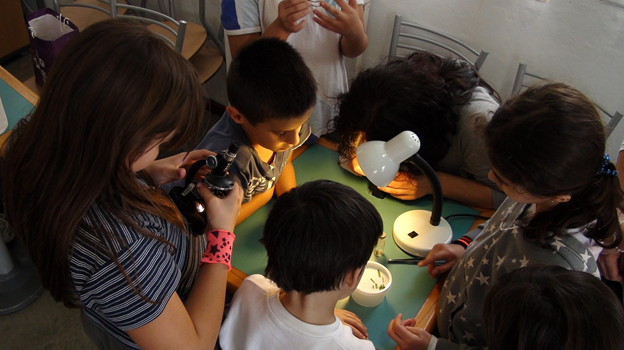
So, you’re entering a science fair. Now what? These six simple science fair tips will take you from picking your project to nailing your presentation. And who knows — you may even have some fun along the way!
Science Fair Tips
Science Fair Tip #1
Pick a topic that interests you. Trust us, it’s much more fun that way! You’ll enjoy working on your project, gathering information, and learning if you’re studying something that matters to you. Spare yourself, your parents, teachers, and the judges from a project that bores you. If you don’t care about your project, it shows. And if you’re project intrigues and inspire you, that shows too! Not sure where to start? Look at these neat Science Fair Project Ideas for some inspiration.
Science Fair Tip #2
Don’t reinvent the wheel with your science fair topic. A good topic can have revolutionary ideas, but more importantly, judges will want to know what you learned (and if you used the scientific method). Hint: It’s OK to take an existing science project and use it as your own! Just modify the variables you test to make your project unique.
Topics that relate to current issues and concerns in society tend to score high points in science fairs. However, you still need to thoroughly think it through and research well to score high. Such topics usually relate to how we can improve or maintain our health, welfare, and/or way of life. We suggest avoiding politically charged topics, if necessary. It is hard to stay neutral, and it is usually hard, if not impossible, to scientifically test your theory.
Science Fair Tip #3
Do your own work. Judges will evaluate what you know about your project and what you learned during the process of your project — from start to finish. If your parent, brother or sister, friend, or classmate does all your work, you won’t learn anything. Where’s the fun in that?
Science Fair Tip #4
Make sure your project is a science project. To be considered a science fair project, your project must use the scientific method and answer a question. So, you must collect and analyze data in order to conclude whether or not your hypothesis was correct. Demonstrating how something works is not a science project. For example, demonstrating a collection of magic eye tricks does not constitute a science project because no data was collected.
However, if you compare how long it takes specific groups of people (such as children and adults, boys and girls) to see the magic eye tricks, then you have a science project. Why? Because you are collecting data and you can use that data to draw conclusions. (Although elementary science fairs have permitted observation/demonstration projects in the past, more and more science fairs also want elementary students to use the scientific method and collect data. Therefore, it’s best to cover your bases and avoid doing a simple observation/demonstration project.)
Science Fair Tip #5
Keep your project simple. Try to test only one variable or one hypothesis in your project. The more experiments in the project, the harder it is to keep track of all the factors that influence your science project. After all, there is always next year to expand on this year’s project. Consult our Science Fair Guide for more information on completing a science fair project.

Science Fair Tip #6
Relax during the interview when presenting your project. The judges aren’t there to torment you or pick apart your project. Instead, they want to see that you did your own work (based on how well you understand your project), that your project addresses all parts of the scientific method, that you did the steps correctly, and that you identified any factors that may have caused inaccurate results. Many judges want to know how you can improve your science project, or what you would change to correct inaccuracies. The best advice we can offer you for the interview is this: know your project inside and out.
Armed with these science fair tips, the scientific method, and our science fair guide, you might be bummed that science fair only comes once a year!