A well-structured Earth Science Curriculum plays an essential role in helping students understand the natural world. The homeschool setting provides a unique chance to investigate scientific principles through direct observation, hands-on experiments, and practical, real-world use. Rather than relying solely on textbooks, an effective approach integrates hands-on learning that brings topics like geology, astronomy, and climate science to life.
Here at Home Science Tools, the focus remains on supporting meaningful science education through practical resources that align with homeschool needs. An Earth science foundation encourages curiosity while helping students connect everyday experiences to scientific principles.
What Defines Earth Science in Homeschool Education
Earth science combines multiple disciplines that explain how the planet functions and how it relates to the broader universe. These areas include:
- Geology, which explores rocks, minerals, and Earth’s structure
- Meteorology, focused on weather patterns and atmospheric changes
- Oceanography, examining oceans and water systems
- Astronomy, which studies space, stars, and planetary systems
A science curriculum in a homeschool setting often blends these subjects into cohesive lessons. This integrated approach helps students see connections between land, water, air, and space without separating them into rigid categories.
Why Hands-On Learning Matters
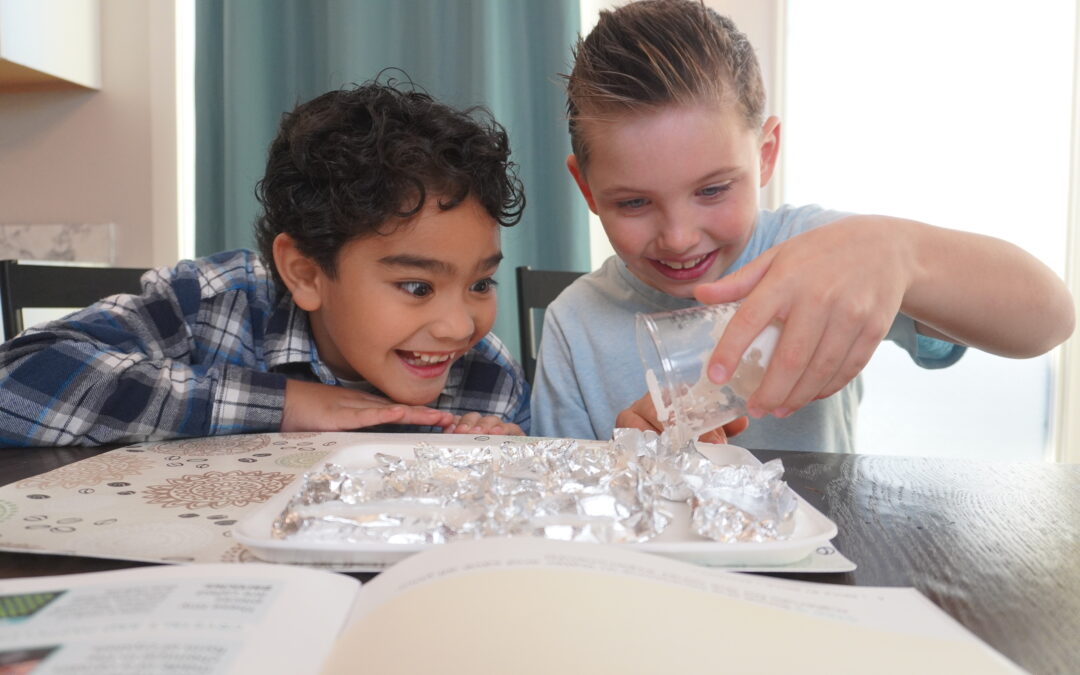
Concepts in Earth science become clearer when students can observe and experiment. Physical interaction with materials reinforces understanding and improves retention.
Examples of hands-on learning include:
- Testing the hardness of minerals
- Building models of the solar system
- Growing crystals to understand formation processes
- Simulating volcanic eruptions or tsunami waves
Our team at Home Science Tools emphasizes the importance of these experiences. Kits and guided activities allow students to actively participate in discovery rather than passively reading about it.
Supporting Homeschool Structure with Flexible Resources
Homeschool education benefits from adaptable materials that can be used across different age groups and learning levels. Earth and space kits offer structured yet flexible ways to introduce complex topics.
Earth and Space Kits for Applied Learning
Earth and space kits are designed to combine education with engagement. Our kits include materials and instructions for experiments that tangibly demonstrate scientific principles.
Common learning opportunities include:
- Creating solar system models to understand planetary relationships
- Investigating rocks and minerals through classification tests
- Studying glowing minerals to explore chemical properties
- Observing weather patterns through simple experiments
These activities align naturally with a science curriculum while allowing students to learn at their own pace.
Project-Based Exploration
Projects extend learning beyond individual experiments and encourage deeper investigation. They also provide opportunities for creativity and critical thinking.
Examples of Earth science projects include:
- Building a model to demonstrate convection currents
- Purifying water using solar energy methods
- Creating fossil casts to understand preservation
- Exploring cave formations and erosion processes
Here at Home Science Tools, resources are designed to support both short experiments and longer-term projects, helping homeschool educators maintain variety in lesson planning.
Encouraging Curiosity Through Real-World Connections
Earth science is uniquely positioned to connect academic learning with everyday observations. Weather changes, rock formations, and night skies all serve as accessible teaching tools.
A strong curriculum incorporates:
- Outdoor observation activities
- Journaling of weather patterns
- Identification of rocks and minerals in natural settings
- Stargazing sessions to explore astronomy concepts
These experiences help students understand that science is not limited to a lesson but is part of the world around them.
Structuring an Effective Homeschool Science Plan
Consistency and progression are key when developing a homeschool science plan. While flexibility is important, having a clear structure ensures that essential topics are covered over time.
Suggested Approach
A balanced Earth science plan may include:
- Weekly experiments to reinforce concepts
- Monthly projects for deeper exploration
- Seasonal studies focused on weather and environmental changes
- Periodic reviews to connect different topics
At Home Science Tools, we recommend combining structured lessons with open-ended exploration. This approach maintains academic rigor while allowing room for curiosity.
Integrating Earth and Space Science Seamlessly
Earth science and space science complement each other naturally. Understanding Earth’s systems often leads to questions about the broader universe.
Topics that bridge both areas include:
- The relationship between Earth and the Sun
- Planetary motion and its effect on seasons
- Atmospheric composition compared to other planets
- The role of gravity within the solar system
Our integrated Earth Science Curriculum helps students build a more complete understanding of how Earth fits within a larger cosmic context.
Bringing Homeschool Science to Life
An engaging homeschool science experience depends on more than information delivery. It requires interaction, exploration, and opportunities to apply knowledge in meaningful ways.
Here at Home Science Tools, the goal is to support families and educators with resources that make science approachable and effective. From Earth and space kits to detailed project guides, each tool is designed to enhance learning while maintaining a sense of discovery.
A thoughtfully designed Earth Science Curriculum allows students to explore everything from the depths of the ocean to distant stars. With the right combination of structure and hands-on activities, homeschool education can foster both understanding and lasting interest in science.
Explore More with Home Science Tools
Our team at Home Science Tools provides a diverse collection of Earth and space science kits, experiments, and project resources tailored for homeschool environments. These materials help create engaging lessons that support scientific growth at every stage.
Discover how practical tools and well-designed activities can strengthen science education and bring an Earth science curriculum to life in any homeschool setting.