Teaching Resources & Guides > Owl Pellet Dissection: A Project to Explore Nature’s Food Web 

Owl Pellet Dissection: A Project to Explore Nature’s Food Web

An owl pellet dissection is an interesting and educational opportunity to learn about owls, their diet, and the role they play in an ecosystem. With any owl pellet dissection, your student can learn about food webs, food chains, animal diet, and habitats. 

Owl Pellet Dissection 

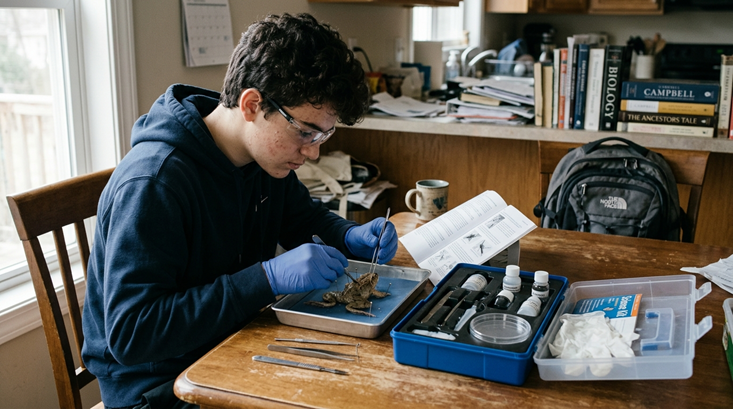
Safety Note: Owl pellets are sterilized to kill bacteria. However, you should never perform an owl pellet dissection near food or drink. Also, do not put any part of the owl pellet in or near your mouth. Make sure to always wear gloves when handling an owl pellet. Importantly, thoroughly wash your hands before and after completing the pellet dissection. 

What You Need:

Instructions:

  1. Put on gloves. Then, observe the owl pellet with the magnifying glass. 
  2. Describe what the owl pellet looks like. 
  3. Using a ruler, measure the length, width, and height of the owl pellet in centimeters (cm).  
  4. Then, you will form a hypothesis about what you think you will find inside of the owl pellet. A hypothesis is a prediction of what you think the answer is or what you think will happen in a scientific experiment. 
  5. Run the owl pellet under water. This will help loosen the material in the owl pellet and reduce the spread of the owl pellet “dust”. 
  6. Then, gently break the owl pellet in half with your hands. You will then place it on a dissection tray. 
  7. Using forceps and a probe, dissect the owl pellet. 
  8. Then, separate the bones from any other materials you find in the owl pellet. 
  9. Dispose of the material that is not bone. 
  10. Finally, observe the bones.  
  11. Lastly, determine what prey animal the owl ate. Use the skull in the owl pellet to help you figure this out! 

Wrapping Up Your Owl Pellet Dissection

You’ve just completed an owl pellet dissection. Well done, scientist! At this point, you’ve examined the bones inside the pellet, and uncovered clues about the owl’s diet and its role in the food web. Pretty amazing, right?

This activity doesn’t just teach you about owls. It helps you see how all animals fit into larger systems like food chains, food webs, and ecosystems. Every pellet tells a story, and now you know how to read it.

So, what’s next? Share what you learned with a friend, teacher, or class. Or better yet, create a chart of the bones you found and compare it to others. After all, science is about curiosity, and you’re just getting started.
Teaching Homeschool

Welcome! After you finish this article, we invite you to read other articles to assist you in teaching science at home on the Resource Center, which consists of hundreds of free science articles!

Shop for Science Supplies!

Home Science Tools offers a wide variety of science products and kits. Find affordable beakers, dissection supplies, chemicals, microscopes, and everything else you need to teach science for all ages!

Related Articles

Changing Ratios: A Balloon Reaction Experiment 

Changing Ratios: A Balloon Reaction Experiment 

In this balloon reaction experiment, students test how changing the amount of baking soda affects how much each balloon inflates. This experiment is part of a Science Unlocked® curriculum, which leads students to observe reactions and test how different amounts...

DIY Thermometer Experiment: How Temperature Changes Matter 

DIY Thermometer Experiment: How Temperature Changes Matter 

With this fun, hands-on DIY thermometer experiment, students move beyond experiencing temperature every day to understanding how temperature actually works. With this experiment from Science Unlocked®, students build tools that let them see temperature change in real...

Squishy Science: Creating a Stress Ball

Squishy Science: Creating a Stress Ball

The stress ball science experiment is a hands-on, fun yet educational way for students to explore physical properties through real design and testing. This activity is one example of how Science Unlocked® turns everyday materials into meaningful science learning. ...

Meteorology for Kids: A Hands-On Air Pressure Experiment 

Meteorology for Kids: A Hands-On Air Pressure Experiment 

Meteorology for kids becomes much more meaningful when students can see and test how the weather works for themselves. After all, understanding the weather isn’t just about checking an app. It's about recognizing patterns and observing changes. That’s exactly what...

Pop Rocket Experiment: See Force and Motion in Action 

Pop Rocket Experiment: See Force and Motion in Action 

The Alka-Seltzer pop rocket experiment is one of those hands-on science activities that immediately draw attention. With a small canister, water, and part of a tablet, you get to watch a mini rocket launch into the air. This experiment comes from Blast Off: Ready,...

should I learn computer coding