Fossils provide insight into the past. Geologists use them to create timelines, study environmental changes, and to make predictions about the future. You can probably identify a bone or rock fossil by sight. The other categories, though, are not as obvious. The process of becoming a fossil (known as fossilization) is quite rare, which is one reason for studying them is so interesting! Read on to learn the science behind fossils.
What Are Fossils?
In simplest terms, fossils are the remains of organisms found in the earth’s strata (rock layers). These organisms have, in some way, been protected from the bacterial action that degrades carbon-based organisms. 
Fossils range from dinosaur bones and teeth to footprints in the mud, to plant imprints.
Other categories include petrified wood, seashells, and organisms preserved in amber.
How Are They Made?
Fossils are created through sudden disruptions, like earthquakes. They can also be formed through steadier processes, like exposure to the (extreme) elements. In most cases, the environment plays a direct role, as a preservative, in whether an organism will become a fossil.
The ideal environment is silty, with moving sediment that can cover the organism. The floors of oceans, lakes, and deep ponds are prime spots for fossilization. Imagine a sick dinosaur pulling itself to a lake for a drink. It dies. The body falls in and sinks to the bottom. The lake’s motion deposits mud and sand on the animal.
Over time, the soft tissues dissolve, and the mineral-rich sediment fills the gaps. Years pass and the minerals harden around the bones, creating a petrified structure we’ve come to know as fossils. Fossils are formed through preservation:
Freezing — ice and low temperatures keep organisms from decaying. Large mammals have been found buried in ice, probably caused by earthquakes and avalanches, in Siberia and Alaska.
Drying — extreme heat, without humidity, can mummify organisms.
Smothering — sticky, naturally occurring substances like tar and amber trap unsuspecting animals.
Carbonization — this process leaves a carbon impression in a rock or soil.
Permineralization — minerals crystallize and hold the shape of the organism.
Why Are Fossils Found in Deserts?
Although it seems that fossils are mostly created in or near water, they also are found in large quantities in deserts.
Why is that?
It appears that the climate of the Earth has changed a lot during its history. What’s desert today could have been semi-tropical forest, with lots of moisture, in the distant past. In fact, rapid change is still happening today. The island of Hawaii, for example, grew by 40 acres between 1983-2000 because of lava flows from the Kilauea Volcano.
Other Fossils
Amber (or resin) fossils are formed when a small plant or animal gets caught in the sticky plant excretions. 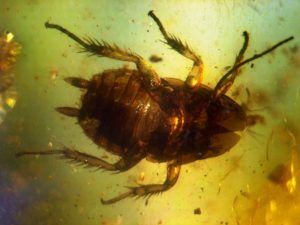 Amber is not sap, it’s a plant or tree’s defense mechanism. It can attract insects, which helps explain why there are so many insects-in-amber fossils! Sunshine dries amber, making it hard. Once encased, the insect would not be able to escape.
Petrified wood is another form of fossil. Whereas the “ideal” material for fossils is hard and non-porous, like bone and seashells, petrified wood breaks the mold.
Ancient trees would fall and rot away, with pieces getting buried in sediment. The minerals would seep into the wood and replace the organic materials, creating a rock-like substance that looks like wood over the centuries.
Further learning
There are many parks in the U.S. and internationally where you can see impressive examples of fossils. While there, you can also study the surrounding environment and note the factors, including rock types, that made fossilization possible.
You can visit museums to see fossils, go on a dig to look for them, or make your own (below).
Thanks to FossilEra, an online retailer of authentic fossils, for this article.
Insect image courtesy of Wikimedia Commons.