
Science Projects > Chemistry Projects > Why Does Lemon Juice Preserve Apples? 

Why Does Lemon Juice Preserve Apples?

Why do apples turn brown?

See it happen, first, in the experiment below.

Then, find out how chemical reactions work to keep your apples (or pears) fresh even after they’ve been cut!

Lemon Juice on Apples

What You Need:

  • An apple or pear
  • Sharp knife
  • Lemon juice
  • Small bowl (big enough to fit half the apple or pear)
  • Clock/timer
  • Paper plates
  • Pen and paper
  • Adult help

What You Do:

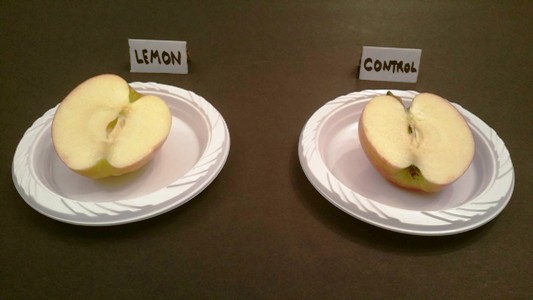
1. Use your pen and paper to make two labels, one reading “control” and the other reading “lemon.”
This image has an empty alt attribute; its file name is ApplesAcidStep2.jpg

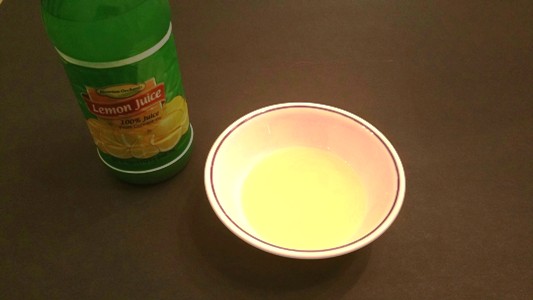
2. Pour lemon juice so it completely covers the bottom of the bowl.
This image has an empty alt attribute; its file name is ApplesAcidStep3.jpg

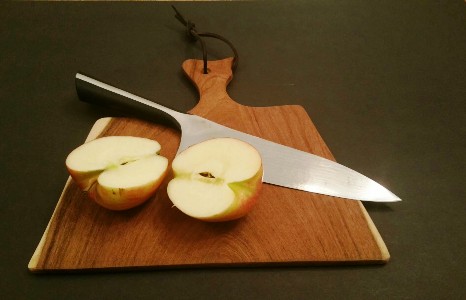
3.  With adult help, cut the apple in half from top to bottom.
soaked lemon juice on apples

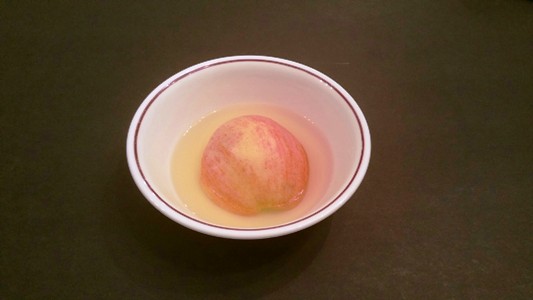
4.  Take one apple half and place it cut-­side down into the bowl of lemon juice. Leave it for two minutes. The other apple half without lemon juice is your ‘control’ sample that lets you see what normally happens to a cut apple.
This image has an empty alt attribute; its file name is ApplesAcidStep5.jpg

5.  Observe the color of both apple halves, then place them white ­part­ up on the plates, with the corresponding labels nearby.
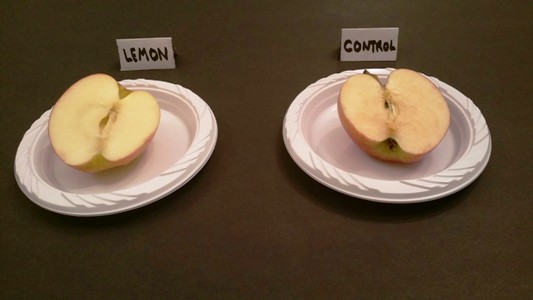
lemon juice on apples (two)

6.  Observe the apples again at 10-­minute increments, up to 30 minutes. Note any color changes and/or differences in appearance.
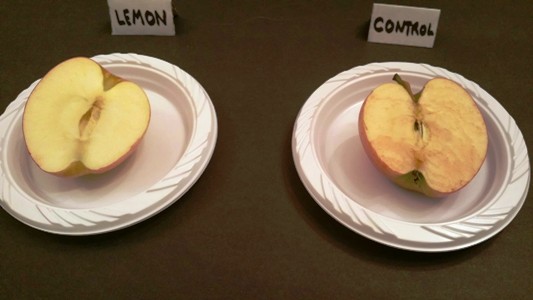
This image has an empty alt attribute; its file name is ApplesAcidStep7.jpg

7.  Look at the apples again periodically throughout the day. What do you find?

What Happened:

When an apple is cut open, an enzyme (proteins that cause chemical reactions) called polyphenol oxidase is released from the cells of the apple and reacts with the oxygen in the air. This reaction causes the fruit to turn brown, similar to rust forming on metal.

Almost all plants contain polyphenol oxidase. It’s believed plants use it for defense. When a plant is damaged, the browning of the affected area may discourage animals and insects from eating it. It may also work to heal the plant. The browning creates an antibacterial effect, limiting the spread of destructive germs.

Lemon juice, however, acts a preservative. Why? Because it’s full of ascorbic acid (an isolate of Vitamin C) and has a low (acidic) pH level.

Ascorbic acid reacts with oxygen before it reacts with polyphenol oxidase. Even when the ascorbic acid is used, the pH of the lemon juice prevents browning. That’s because polyphenol oxidase works best in the 5 to 7 range on the pH scale. Lemon juice’s pH level is about 2, which keeps the polyphenol oxidase inactive.

More food preservation options

In addition to lemon juice, lime juice and cranberry juice also have a pH below 3.0. Concord grape juice and grapefruit juice also have a low pH (not quite as low as the others), but will help delay the browning process. You may want to try several of these juices and find a tasty to way to serve sliced apples and pears in the process!

To learn more about acids, bases, and pH, check out this science lesson.

More Chemistry Projects:

Chemistry

Welcome! Read other Chemistry articles or explore the rest of the Resource Center, which consists of hundreds of free science articles!

Shop for Chemistry Supplies!

Home Science tools offers a wide variety of Chemistry products and kits. Find affordable beakers, test tubes, chemicals, kits, and everything else you need for lab experiments.

Related Articles

How to Plan a Homeschool Science Year

How to Plan a Homeschool Science Year

If you’re wondering how to plan a homeschool science year and feeling a bit overwhelmed, take a deep breath—you’re in the right place. Planning your science year doesn’t have to be complicated; in fact, it can even be fun. With the right tools and a bit of thoughtful...

Geology Activities for Kids

Geology Activities for Kids

When it comes to hands-on science, geology activities for kids are some of the easiest (and most fun) to start with. After all, rocks are everywhere, free to collect, and full of hidden stories! Surprisingly, an ordinary pebble in your driveway might be millions of...

STEM-Friendly Home Environment: How to Create One for Kids 

STEM-Friendly Home Environment: How to Create One for Kids 

Creating a STEM-friendly home environment makes scientific exploration more accessible and enjoyable for both kids and parents. Whether you're homeschooling or simply encouraging curiosity at home, a thoughtfully prepared space and the right tools can help nurture...

Fun Science Activities for Kids and Families 

Fun Science Activities for Kids and Families 

Looking for fun science activities for kids that also encourage connection, creativity, and curiosity? These five hands-on experiments and DIY science projects are perfect for families and educators who want to make science feel personal, joyful, and meaningful....

Explore Like an Entomologist: Fun Bug Science for Kids 

Explore Like an Entomologist: Fun Bug Science for Kids 

Explore like an entomologist and dive into the fascinating world of insects, from buzzing bees to ants marching along sidewalks—your child can start studying these important creatures just like the scientists do! Insects are everywhere, from buzzing bees in blooming...

should I learn computer coding