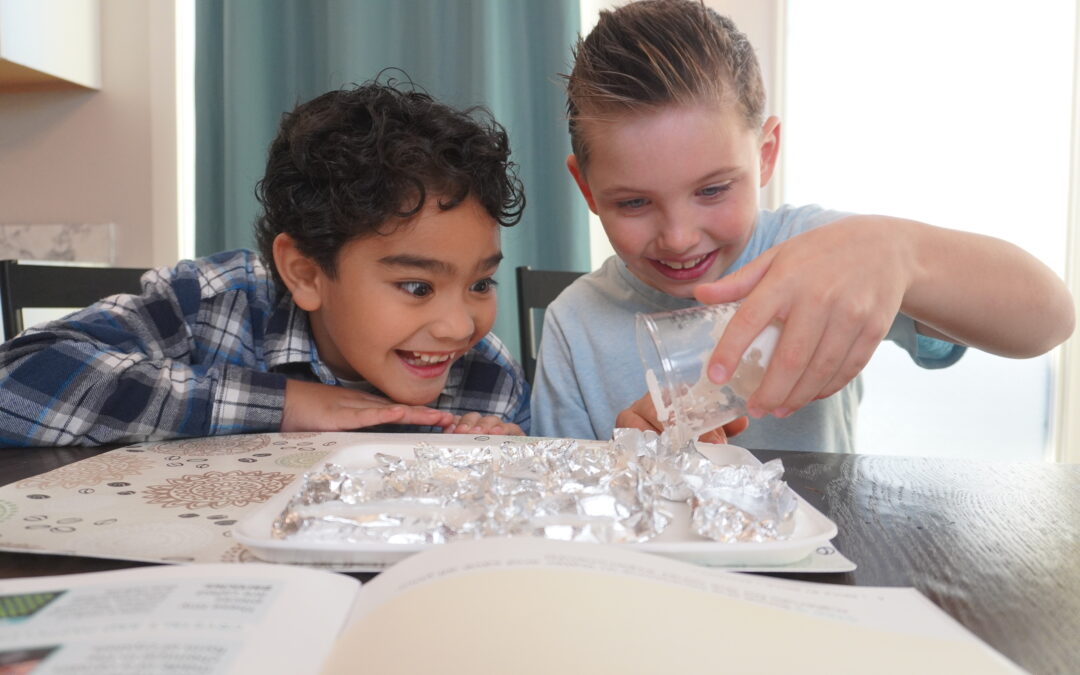
You don’t need to go to a chemistry lab to find acids and bases. These chemicals are part of your life every day! Have you ever bit into a lemon? That sour sensation is citric acid reacting with the taste buds on your tongue. Have you ever dropped a wet bar of soap and found that it was hard to pick it back up? That’s because bases are often slippery to the touch.
Scientists keep track of acids and bases using the pH scale. pH stands for “potential of hydrogen,” and the scale assigns values from zero through 14. Substances with a pH less than seven are acidic and a pH greater than seven are basic. A pH of zero is virtually pure acid. Some common acids are vinegar (or acetic acid), citrus juice, and urine!
In the middle of the pH scale is distilled water. With a pH of seven, it’s considered neutral, which means it’s not an acid or a base. At the top of the scale, a pH of 14 is virtually pure base. Sometimes bases are also called alkaline (say: al‐KUH‐line). Some common bases are egg whites, ammonia, and toothpaste!
How do acids and bases behave? When dissolved in water, an acid releases hydrogen ions (H+) and the solution becomes acidic. Hydrogen ions are hydrogen atoms that have lost an electron and now have just a proton, giving them a positive electrical charge. On the other hand, when a base is mixed with water, it releases hydroxide ions (OH‐). If a solution has a high concentration of H+ ions, then it is acidic, with a low pH number. If a solution has a high concentration of OH‐ ions, then it is basic, and has a high pH number.
What happens when acids and bases are mixed? In many reactions between an acid and a base, they combine to create water and salt. The H+ ions of an acid are neutralized by the OH‐ ions of the bases. In other words, the negatives and the positives cancel each other out! When that happens, different substances can be released in the reaction.
You’ve encountered this if you’ve ever mixed baking soda and vinegar (also called acetic acid) together to make a “volcano.” The baking soda, a base, reacts with and neutralizes the acid that is in vinegar. This releases carbon dioxide gas, which causes the fizzing action. An acidic solution is neutralized when a base is added to it, and a basic solution is neutralized by the addition of an acid.
For further study, follow these instructions for the classic baking soda and vinegar volcano experiment. Then, try this easy project to see how acid can keep sliced apples from turning brown.