Agar is the medium that is used to grow bacteria cultures.
Order nutrient agar for general culturing. Our sterile, 125 ml bottle of nutrient agar is easy to use. Just warm it until it melts and fill your petri dishes. One bottle fills about 10 dishes.
We recommend disposable plastic petri dishes for general culturing. These 90 mm non-reusable dishes are pre-sterilized in packages of 20. Glass petri dishes can be heat sterilized and are reusable.
Get everything you need in one easy kit: Bacteria Experiment Kit
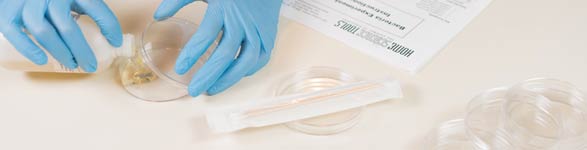
Hot water bath:
Loosen cap (do not remove). Place bottle in 170-190°F hot water bath until liquid (about 1 hour). Keep water line and agar line even to prevent tipping. Warning: Bottle will be very hot. Use caution.
Microwave method:
Or, remove cap completely and microwave on high for 30 seconds. Swirl bottle and repeat in 15-second increments until agar begins boiling and is melted. Use heat-resistant gloves on hot bottles. Warning: Bottle will be very hot. Use caution.
Dehydrated agar must be mixed with water to dissolve. One re-hydrated package fills about 15-20 dishes. Mix 1 level teaspoon of dehydrated agar with 100 ml (3/8 cup) of water and then bring to a boil to make 100 ml of agar solution.
Prepare Petri Dishes:
Fill petri dishes to just cover the bottom. Typical 90-100mm dishes require 10-15 ml agar.
Rotate the dish to obtain even surface coverage.
Cover the dish immediately and let stand until firm. Store upside down in the refrigerator until ready to use. Treat every bacteria culture with great caution.
Once the dishes are prepared with solidified agar, use a sterile cotton swab or inoculating needle (heat-sterilized and allowed to cool) and take a bacteria sample (try swabbing the inside of your cheek!).
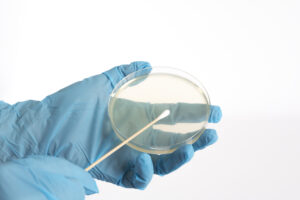
Very gently rub the swab over the agar in a few strokes and replace the lid to the dish.
Allow the dish to sit in a warm, preferably damp area for 2-3 days. It’s a good idea to record the growth each day with a drawing and written description.
Clean Up:
To dispose of a bacteria culture, add 1 tablespoon household bleach, recover the dish, and seal in a plastic bag.
Ideas for experiments with agar and petri dishes can be found in our Bacteria Experiments Science Project.