
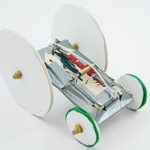
Are mousetraps good for anything more than catching mice? Actually, yes! Build a mousetrap car to learn how stored, potential energy is converted into kinetic energy! This ultimate DIY science challenge is a fun (and educational) way to use the energy from a mousetrap to power a car (although your mousetrap car probably won’t go super far or fast).
When you finish building a mousetrap car, you can try building more complex car designs with the suggestions listed at the end of the article.
SAFETY NOTE: Mousetraps are dangerous! If a mousetrap snaps back on your hand, it could break your finger. So, you will need adult permission and supervision for this project.
What You Need for Your Mousetrap Car
- Wooden snap-back mousetrap
- Duct tape
- 4 eye hooks
- Wooden dowel that fits inside the eye hooks
- Heavy cardboard
- Large and small rubber bands
- Foam board (usually found at a craft store)
- String
- Ruler or straight edge
- Utility knife
- Pliers
How to Build Your Mousetrap Car
Steps 1-8:
1. Cut four wheels out of a piece of foam board or corrugated cardboard (adult supervision is necessary).
2. Then make the back wheels about double the diameter of the front wheels. You could use a compass to draw the circles or trace around a bowl or cup.
3. Give your wheels traction by stretching large rubber bands around each one. For the small wheels, you can also use a section of a balloon.
4. Use pliers to remove any metal or plastic teeth on the mousetrap. Also, remove the rod that sets the trap.
6. Cut a piece of strong cardboard so that it is slightly larger (about 1/2″) than the mousetrap on every side. This will be the base of the car, known as the chassis.
7. Use duct tape to attach the mousetrap to the chassis. Do not cover the middle spring of the trap or, specifically, the “snapper arm.”
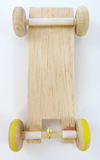
8. Screw the eye hooks onto the bottom of the cardboard chassis, one in each corner. Then, use a ruler to make sure the eye hooks are aligned with each other.
Steps 9-16:
9. Cut the wooden dowel so you have two pieces that are both about two inches longer than the width of the chassis. These will serve as the axles that rotate the wheels.
10. Stick the dowels through the eye loops. Make sure, however, that the axles are straight and that there is room for them to spin in the eye hooks.
11. Cut holes a little bit smaller than the dowels, through the center of each wheel. Then, attach the wheels to the chassis. Place the large wheels on the back of the car, opposite the snapper arm.
12. Wrap a small rubber band around the axle on either side of each wheel so the wheels can’t fall off.
13. Tie a string very tightly to the snapper arm on the mouse trap. The string should be long enough to just reach to the back axle.
14. Carefully pull the snapper arm until it reaches the other end of the trap. (You may need help.)
15. Hold the snapper arm in place and wrap the string tightly around one side of the axle. Meanwhile, holding the string tightly, set the car on the ground and carefully let go of the trap. Wind the string tight enough to hold the trap in place.
16. Lastly, let go of the string, making sure all hands are out of the way! The trap will snap forward, propelling the car accordingly.
What Happened
A set mousetrap is full of potential energy which, when released, converts to kinetic (motion) energy. Therefore, the design of your car allows that energy to transfer to the axle, making the wheels turn. When the trap snapped closed, it yanks the string forward. As the string pulls, friction between it and the axle cause the axle to rotate, spinning the wheels and moving the mousetrap car forward.
Ways to Improve Your Design
There are many different ways to build a mousetrap car. Your simple model moves the car a few feet, but how can you design it to go longer distances or to go faster? Well, here are some things to think about:
Wheel-to-Axle Ratio
Larger wheels work best for distance cars. Every time the axle turns, so do the wheels—if the wheels have a much larger diameter than the axle, the mousetrap car will travel further on each turn of the axle than it would if the wheels were smaller. You will need more force to accelerate a car with a large wheel-to-axle ratio, so smaller wheels work better if you want your mousetrap car to be fast.
Inertia
Newton’s first law of motion states that objects at rest tend to stay at rest, and objects in motion tend to stay in motion unless acted on by an external force. Inertia is the tendency to resist changes in motion, and the more inertia something has, the more force you will need to change its state of motion. Therefore, if your mousetrap car is heavy, you will need greater force to get it moving. To avoid too much inertia, think about how you can build a lighter car.
The Rate of Energy Release
If you release the energy from the mousetrap quickly, your car will accelerate quickly and run faster. However, it will also run out of energy sooner. On the other hand, if you release the energy from the mousetrap slowly, the car will move slower but will be powered for a longer distance. One way to try making the energy release slower is to lengthen the lever arm by attaching something (pencil, dowel, etc.) to the snapper arm and tying the string to the end of that. (This will give you a longer piece of string than the one tied directly to the snapper arm.)
Friction
Analyze all the points of friction on your car where two substances rubbing together can slow the car down or bring it to a stop. Consider how you can reduce friction between your axle and the eye hooks attaching them to the body of the car. However, some friction is good because it enables the wheels to grip the floor, which is called traction. Without it, the force of the trap might cause your wheels to “spin out” instead of propelling the mousetrap car forward. In the procedure above, you used rubber bands to provide traction, but can you think of a better way?
Other Ideas for Improving Your Mousetrap Car
- Improve durability by using lightweight wood such as balsa or basswood instead of cardboard.
- Use CDs or records can as the wheels.
- Glue a small hook to the axle and then connect the string to it with a small loop. Next, wrap the string by turning the wheels in reverse.