QUESTION FOR KIDS: Can you match a fingerprint to its owner?
One of the most important pieces of evidence is still a person’s fingerprints. We leave behind fingerprints almost every time we touch something, and since every person has a unique set of prints, they are a great tool for identification.

Materials for this activity:

- Slides, plain glass
- Blower Brush
- Fingerprint Powder
- Stamp Pad, Black
- Clear tape
- White paper
Follow this easy, step-by-step activity:
In this activity, kids will learn how to collect fingerprints using professional forensics methods. They’ll then compare different fingerprints to determine how they are different. Finally, they can collect fingerprints from common household locations and try to match the print to the person who left it.
1. Touch a microscope slide with your finger to leave a fingerprint.
2. Sprinkle a little bit of powder on the microscope slide, then gently swipe off the excess with a soft brush.
3. Stick a piece of clear tape over the fingerprint firmly and carefully lift up. Place the tape on a piece of white paper to look at the print closely. What are the characteristics and patterns of the fingerprint?
4. Try lifting a print from a door handle or faucet and see if you can identify whose print it is. Using the stamp pad and a piece of white paper, collect fingerprints from everyone in your family and label them to compare to other prints.

A few tips to help you out:
 Fingerprint powder and stamp pads can be messy!
- It might take a little practice to perfectly powder a fingerprint. If it smudges when you wipe off the powder, try brushing lighter.
- Collect your family’s fingerprints with a stamp pad or by powdering them.
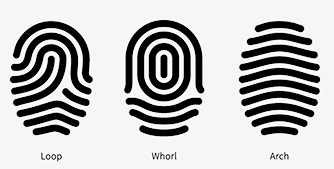
- There are 3 main types of fingerprint patterns: loops, whorls, and arches. What types do you see in your collection?
Go Beyond the Activity
- Learn about solving crime at a crime scene with our Crime Scene Science Kit. Includes fuming for fingerprints, blood analysis, fabric analysis and more!
- Try even more forensics experiments, just like the professionals, with the Forensics Kit Pro.
Download
Download the activity sheet for a formatted and ready-to-print version of this page.