
Cloud Science Projects
The Water Cycle
In this experiment, you will see how water from the ground gets into the air to form clouds and then falls back to the ground as rain!
What You Need:
- Paper cup
- Plastic zip bag (large enough to hold the cup standing up)
- Tape
- Water
What to Do:
1. Fill the cup about 1/4 full with water.
2. Then, carefully set the cup inside the plastic bag and zip it shut.
3. Tap the bag to a window where a lot of sun shines in.
4. Finally, you will check your cup and bag throughout the day and watch what happens.
What Happened:
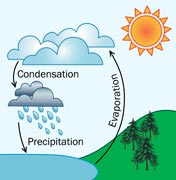 As the sun heated up the water in the cup, some of the water evaporated into a gas called water vapor.
You can’t see water vapor, but you could see what happened next. In sum, the water vapor turned back into a liquid, and little drops of water formed on the inside of the bag. This is called condensation.
When several droplets of water stuck together, they became heavy enough to pull each other down the sides of the bag.
If you left this project taped to your window for long enough, all of the water from inside the cup should eventually end up in the bottom of the bag!
This is exactly how clouds form and make rain.
Water from rivers, lakes, streams, and oceans evaporates into the air when it is heated up by the sun. Then, as the water vapor rises up in the air, it condenses, or starts to cool down, and turns back into a liquid.
Then, droplets of water start to stick together as clouds. When enough droplets stick together in the clouds, they become large and heavy and are pulled down toward the earth by the force of gravity.
When water drops fall from clouds, it is called rain. Sometimes, the droplets freeze before they reach the ground and become hail, sleet, or snow!
Cloud in a Jar
Did you know you can make a cloud? However, the cloud you make will be much smaller than the ones in the sky, but it will form in the same way.
What You Need:
- A glass jar
- Black paper
- Tape
- Warm water
- Ice cubes
- Small metal bowl or a metal baking sheet (should completely cover the opening of the jar)
- A match
- A flashlight (optional)
- An adult to help
What to Do:
1. Cut the black paper to fit halfway around the jar, leaving about one inch of space at the bottom of the jar. Tape it in place on the jar.
2. Add about two inches of warm water to the jar.
3. Fill the metal bowl or tray with ice cubes.
4. Have an adult light a match and hold it inside the jar for a few seconds and then drop it into the water.
5. Quickly cover the jar with the container of ice.
6. Look into your jar from the open side (so that the black paper makes a background at the back of the jar) and watch what happens.
7. You should start to see a cloud form! As the cloud gets bigger, it will be easier to see. To see the cloud better, turn off the lights and shine a flashlight into the jar toward the black paper.
8. After watching your cloud for a while, you can take the container of ice off of the jar and watch the cloud rise up and disappear!
What Happened:
Clouds are formed when water warms up and changes into a gas called water vapor, which rises up into the air.
As it rises higher in the sky, the water vapor cools down and turns back into tiny drops of liquid.
Inside the jar, some of the warm water evaporated into water vapor.
Then, as water vapor hit the cold metal bowl of ice, it turned back into tiny droplets of liquid water.
The smoke from the match that was held in the jar helped make the cloud easier to see.
The tiny droplets of water stuck to tiny bits of smoke in the air between the warm water and the ice.
In a real cloud, tiny pieces of dust floating in the air work the same way as the smoke did in your jar, and the water droplets form around the dust.
As more water changed into water vapor and then back into tiny water droplets, the cloud grew.
When you removed the container of ice, the water vapor didn’t condense back into drops of water; it rose out of the top of the jar, taking your cloud with it!
Cloud Science Lesson
What Are Clouds?
Heat from the sun causes tiny drops of water to move from the ground into the air.
When water molecules warm up, they change from a liquid into a gas and rise up into the air, or evaporate.
Water that has evaporated is called water vapor. Steam from a pot of water boiling on the stove is also water vapor. There is a lot of water vapor in the air we breathe.
 Clouds are formed when water vapor rises high up into the air. When it reaches cold air, the vapor turns back into droplets of water!
Those tiny drops of water floating in the air collect and “stick” together in the sky. Clouds are just lots of drops of water all stuck together.
When clouds get full of water droplets that they can’t hold any more, the water falls back to the ground as rain.
Sometimes, water droplets freeze and fall to the ground as snow, sleet, or hail. Water or ice that comes from clouds is called precipitation.
Besides bringing precipitation, clouds also keep the earth cool. Warm air always rises and cool air sinks.
On nights when there are lots of thick clouds, the earth does not lose its heat as fast because the clouds block the warm air from rising up as much.
Cloudy nights are usually warmer than clear nights. On nights when there aren’t many clouds, the heat rises up into the atmosphere, cooling the temperature of the earth.
Types of Clouds
There are three main types of clouds, but there can also be combinations of these clouds, and other names for them depending on how high they are in the sky. To learn more about cloud types and observing them to predict weather, we recommend a cloud chart.
Cirrus – thin and wispy clouds very high in the sky. They are often made of tiny pieces of ice and usually occur the day before rain or snow. The word cirrus comes from a Latin word that means “tuft or curl of hair.”
Cumulus – large, fluffy clouds that are in the sky on days with nice weather (no precipitation). The word cumulus means “pile” or “heap.” Cumulus clouds can turn into clouds that bring thunderstorms, called Cumulonimbus clouds.
Stratus – dark layers of clouds that hang low across the sky like a blanket. The word stratus means “to spread out.” Stratus clouds can bring rain, snow, or fog.
Science Words
Evaporate – when molecules warm up and change from a liquid into a gas.
Water vapor – when water from the Earth evaporates into the air, it becomes a gas and is called water vapor.
Condense– when a gas cools down and turns back into a liquid.
Printable Worksheet
Use this worksheet with the “Types of Clouds” section of the Science Lesson above to review the basic types of clouds and what kind of weather they bring.