Teaching Resources & Guides > Worksheets & Printables > Forensic Fingerprints Activity 

Forensic Fingerprints Activity

QUESTION FOR KIDS: Can you match a fingerprint to its owner?

One of the most important pieces of evidence is still a person’s fingerprints. We leave behind fingerprints almost every time we touch something, and since every person has a unique set of prints, they are a great tool for identification.

Materials for this activity:

Get what you need for this activity -- Shop Now!

Follow this easy, step-by-step activity:

In this activity, kids will learn how to collect fingerprints using professional forensics methods. They’ll then compare different fingerprints to determine how they are different. Finally, they can collect fingerprints from common household locations and try to match the print to the person who left it.

1. Touch a microscope slide with your finger to leave a fingerprint.

2. Sprinkle a little bit of powder on the microscope slide, then gently swipe off the excess with a soft brush.

3. Stick a piece of clear tape over the fingerprint firmly and carefully lift up. Place the tape on a piece of white paper to look at the print closely. What are the characteristics and patterns of the fingerprint?

4. Try lifting a print from a door handle or faucet and see if you can identify whose print it is. Using the stamp pad and a piece of white paper, collect fingerprints from everyone in your family and label them to compare to other prints.

Fingerprint Powder

A few tips to help you out:

  • Fingerprint typesFingerprint powder and stamp pads can be messy!
  • It might take a little practice to perfectly powder a fingerprint. If it smudges when you wipe off the powder, try brushing lighter.
  • Collect your family’s fingerprints with a stamp pad or by powdering them.
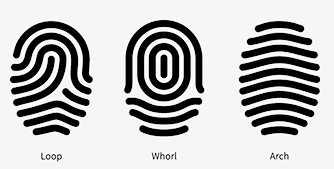
  • There are 3 main types of fingerprint patterns: loops, whorls, and arches. What types do you see in your collection?

Go Beyond the Activity

  • Learn about solving crime at a crime scene with our Crime Scene Science Kit. Includes fuming for fingerprints, blood analysis, fabric analysis and more!
  • Try even more forensics experiments, just like the professionals, with the Forensics Kit Pro.

Download

Download the activity sheet for a formatted and ready-to-print version of this page.

Teaching Homeschool

Welcome! After you finish this article, we invite you to read other articles to assist you in teaching science at home on the Resource Center, which consists of hundreds of free science articles!

Shop for Science Supplies!

Home Science Tools offers a wide variety of science products and kits. Find affordable beakers, dissection supplies, chemicals, microscopes, and everything else you need to teach science for all ages!

Related Articles

Guiding Thinking, Not Managing Chaos 

Guiding Thinking, Not Managing Chaos 

How One Extended Learning Program Transformed What Science Instruction Looks Like  Home Science Tools | Summer of Success Series  There is a version of after-school science that most programs know well: a facilitator who is doing their best, working from a...

When After-School Science Works: Lessons from the Field

When After-School Science Works: Lessons from the Field

Home Science Tools | Summer of Success Series Out-of-school time programs occupy a position in a student's educational life that is genuinely different from the regular school day — not supplementary to it, but distinct from it in ways that matter for how...

Building a Strong Earth Science Curriculum for Homeschool Learning

Building a Strong Earth Science Curriculum for Homeschool Learning

A well-structured Earth Science Curriculum plays an essential role in helping students understand the natural world. The homeschool setting provides a unique chance to investigate scientific principles through direct observation, hands-on experiments, and practical,...

Inspiring Future Scientists with the Power of a Digital Microscope

Inspiring Future Scientists with the Power of a Digital Microscope

The journey of scientific discovery often begins with a single moment of wonder. For children and adolescents, the ability to see the intricate details of a honeybee’s wing or the complex cellular structure of a leaf can spark a lifelong passion for the STEM fields....

Recreating Famous Science Experiments at Home

Recreating Famous Science Experiments at Home

Science history isn’t just something to read about in a textbook; it’s something that should be experienced firsthand. At Home Science Tools, we believe some of the most powerful learning happens when students do science, not just study it. Many of the world’s most...

should I learn computer coding