Background on Mousetraps
With just a few parts (a wooden base, a spring, a metal bar, and a trigger mechanism) it can do its job quickly and efficiently. It is so simple and functional that it has created a cliche: “to build a better mousetrap” means to improve on the best, or reach the heights of achievement.
But it isn’t just a figure of speech; people continue trying to build a better mousetrap. There are already 4,400 mousetrap patents issued by the Patent Office, and 400 people apply for new patents every year! But only a couple dozen of those thousands of mousetrap designs have ever made money, and the simple snap-back is still selling strong more than one hundred years after it was patented in 1899.
Not only can this machine get rid of mice, it can teach us a lot about physics, too!
How Does a Mousetrap Work?
When a mousetrap is set, the spring in the center is compressed, becoming a source full of potential energy. This energy is being stored, not used, but as soon as the trap is released, it is converted to kinetic energy (the energy of motion) that propels the snapper arm forward.
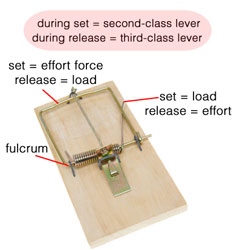 A mousetrap makes use of a simple machine called a lever.
There are three different classes of levers. A first-class lever is like a teeter-totter at the park. The pivot point is called the fulcrum, the person being lifted is the load, and the person on the other end is the effort force.
A lever makes doing work easier. You can lift someone with a teeter totter much easier than if you tried to pick them up!
Second- and third-class levers have different arrangements of the components of a lever. The fulcrum, or pivot point, is at one end, instead of in the middle.
In a second-class lever the effort force is at the other end, with the load in the middle.
In a third-class lever, the load is at the end and the effort force is between the fulcrum and the load.
When you set the mousetrap, you are using a second-class lever. The load is the arm of the spring that is being pushed down to compress the spring. The effort force is your fingers on the end of the snapper arm, and the fulcrum is the pivot point in the middle of the trap. When the mousetrap is released, however, it acts as a third-class lever. The snapper arm becomes the load, and the spring arm becomes the effort force moving the load.
Of course, all that potential energy can be put to other uses besides getting rid of mice. In the projects below, you’ll use a mousetrap as a power source for a catapult and a car!