Science lessons can become highly engaging when students investigate objects that appear ordinary at first glance. A digital microscope provides an opportunity to examine tiny structures, record observations, and create projects based on real specimens. These activities support skills in biology, environmental science, photography, data collection, and scientific communication.
At Home Science Tools, we recognize the value of hands-on exploration in science education. Microscopy activities can turn familiar materials into subjects for careful investigation and provide practical ways to connect scientific concepts with everyday observations.
1. Investigate Plant Structures
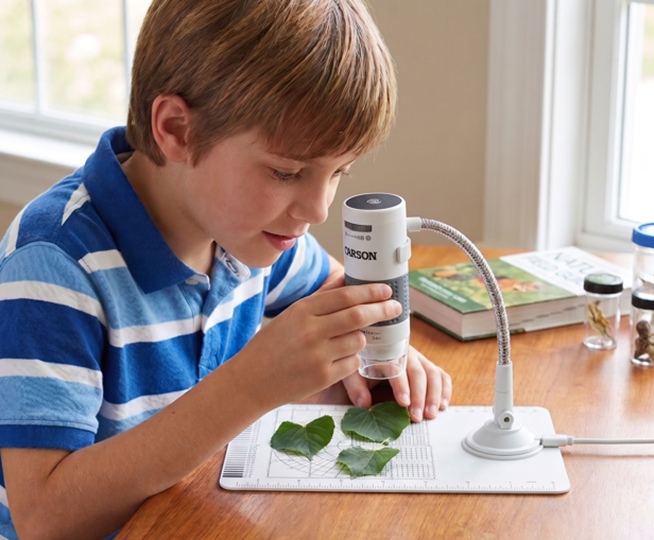
Plants provide accessible specimens for microscopy projects. Leaves, stems, petals, and roots contain structures that reveal how plants function.
A simple project can compare several types of leaves. Students can photograph each specimen and examine differences in veins, surface textures, and cellular patterns.
Possible specimens include:
- Grass blades
- Flower petals
- Tree leaves
- Moss
- Thin pieces of vegetable tissue
Images can be organized into a visual plant journal. Labels can identify each specimen, collection location, date, and observed features.
Extend the Investigation
A comparison between healthy and damaged leaves can add another layer to the project. Changes in texture, coloration, or surface structure may provide clues about environmental conditions.
The activity also creates an opportunity to discuss photosynthesis, plant adaptation, and the movement of water through plant tissues
2. Examine Household Fibers
Fabric and fibers can reveal striking differences under magnification. Cotton, wool, silk, synthetic fabrics, and paper contain distinct structures that can be compared through detailed images.
A fiber investigation can begin with small samples from different materials. Students can record the texture and appearance of each specimen before examining them under magnification.
A digital camera makes it possible to capture images for later comparison. The finished project could include a chart showing the source, texture, visible structure, and microscopic appearance of each material.
This activity connects microscopy with materials science while encouraging careful classification.
3. Create a Crystal Collection
Crystals provide an accessible introduction to patterns, symmetry, and mineral structures. Common household substances can produce visually interesting specimens after crystallization.
Salt and sugar are practical starting points. A small amount can be dissolved in water and left to crystallize on a suitable surface.
Once crystals form, images can document their shapes and arrangement. Different concentrations or drying conditions can create opportunities for comparison.
Students can record:
- The substance used
- The amount of water
- The preparation method
- Crystal shape and size
- Visible differences between samples
The resulting collection can serve as a brief science report, supported by photographs.
4. Explore Insect Anatomy
Insects provide fascinating subjects for observational science. Wings, legs, antennae, and body surfaces can reveal structures that are difficult to see without magnification.
Naturally shed insect parts can serve as specimens for these activities. Ethical specimen collection should avoid harming living insects.
A digital microscope can capture images of individual structures for labeling and comparison. Students can investigate how wing textures differ between species or examine the tiny structures found on insect legs.
These observations can lead into discussions about adaptation, movement, camouflage, and classification.
5. Study Pond Water and Natural Samples
Water from ponds, streams, or other suitable outdoor sources can contain microscopic organisms and particles. A prepared slide can provide an opportunity to examine these samples in greater detail.
Students can compare samples from different locations and document visible differences. Photos and videos can help preserve observations that might otherwise be difficult to describe.
Proper hygiene and safe specimen-handling practices should guide every investigation involving environmental samples.
This type of project also introduces concepts related to ecosystems, biodiversity, and water quality.
Turning Observations Into Science Projects
Microscopy becomes especially valuable when observations are organized into a structured investigation. A strong project can include a research question, a hypothesis, a materials list, a procedure, observations, images, and a conclusion.
Digital images provide useful evidence for reports and presentations. Students can add labels, measurements, captions, and notes to explain what each image shows.
These projects can also support skills in:
- Scientific writing
- Visual documentation
- Data organization
- Measurement
- Evidence-based reasoning
- Presentation design
The resulting work can be included in a science portfolio.
Connecting Microscopy With Other Subjects
Microscope projects can support several areas of study within a single activity. Photography introduces composition and image organization. Writing develops scientific vocabulary and reporting skills. Mathematics can support measurements and comparisons.
Art projects can also emerge from microscopic patterns. Leaves, crystals, fibers, and natural textures can provide inspiration for drawings, collages, or digital presentations.
At Home Science Tools, we encourage families and educators to use hands-on activities as opportunities for deeper scientific exploration. A well-planned microscopy project can transform familiar specimens into engaging research subjects.
Continue Exploring With Home Science Tools
A digital microscope can support creative investigations ranging from plant studies to crystal analysis. Captured images and videos also give students a lasting record of their discoveries.
At Home Science Tools, our selection of microscopes, cameras, prepared slides, and science resources supports hands-on learning across many scientific disciplines. Explore our educational resources to find tools that can help bring future science projects into sharper focus.