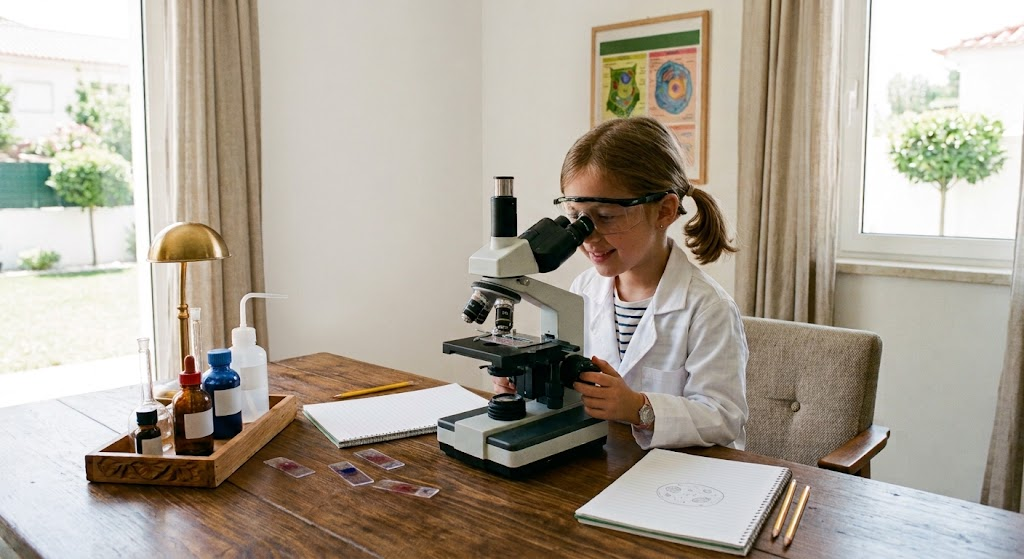
Do you need help learning how to effectively use a compound microscope?
Believe it or not, but it’s not as complicated as it may look! We’re confident that these instructions will help you become comfortable and proficient with your microscope.
How to Use Your Compound Microscope |
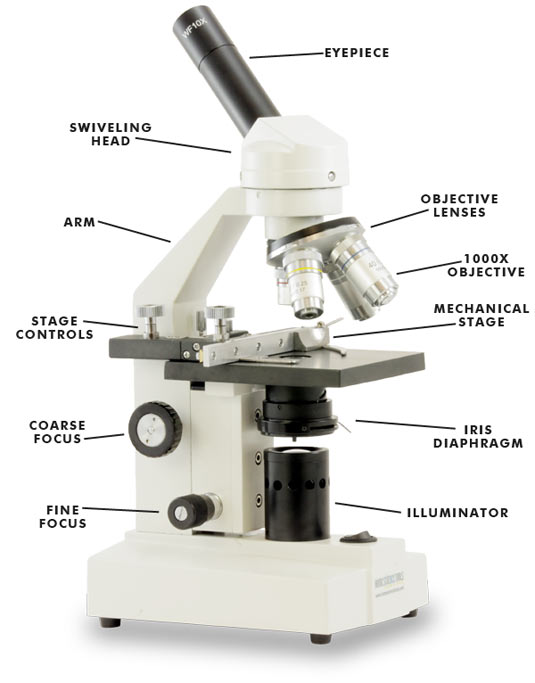
| Step 1: Set your microscope on a tabletop or other flat, sturdy surface where you will have plenty of room to work. Plug the microscope’s power cord into an outlet. (Note: some compound microscopes don’t use electric lighting but have a mirror to focus natural light instead.) Switch on your microscope’s light source and then adjust the diaphragm to the largest hole diameter, allowing the greatest amount of light through. If you have an iris diaphragm, slide the lever till the most light comes through. See the diagram below for help locating these parts. Step 2: Rotate the nosepiece to the lowest-power objective (usually 4x for 40x magnification). It is easiest to scan a slide at a low setting, since you have a wider field of view at low power. Step 3: Place a microscope slide on the stage, either under the stage clips or clipped onto the mechanical stage if your microscope has one. A prepared slide works best when you do this for the first time. (If you do not have a prepared slide, place a strand of colored yarn or thread on a blank slide and place a coverslip over it.) Move the slide until the specimen is under the objective lens. Step 4: Adjust the large coarse focus knob until the specimen is in focus. Slowly move the slide to center the specimen under the lens, if necessary. Do this by gently nudging it with your fingers or turning the slide control knobs if you have a mechanical stage. Step 5: Adjust the small fine focus knob until the specimen is clearly in focus. Then adjust the diaphragm to get the best lighting. Start with the most light and gradually lessen it until the specimen image has clear, sharp contrast. (Note: Some microscopes have only one focus knob, for “intermediate” focus.) Step 6: Scan the slide (right to left and top to bottom) at low power to get an overview of the specimen. Then, center the part of the specimen you want to view at higher power. Rotate the nosepiece to the 10x objective for 100x magnification. Refocus and view your specimen carefully. Step 7: Adjust the lighting again until the image is clear (you will need more light for higher power). Repeat with the 40x objective for 400x magnification, which will enable you to see the specimen detail necessary for high school biology lab work.
|
Diagram of Microscope Parts |
 |
Microscope Cleaning and Maintenance |
| To clean the exterior side of lenses, use a non-solvent cleaning solution designed for cleaning optics or eyeglasses. First, remove dust with a soft brush or a can of compressed air. Then moisten a piece of lint-free, dry tissue or lens paper, and clean the lens surfaces with a circular motion. Repeat with a second piece of paper moistened with lens solution if necessary. Repeat once again with dry lens paper until the lens is clean and dry. Use this same procedure for the eyepiece and objective lenses. To clean the interior side of the lenses, DO NOT use the procedure above. Instead, use a bulb-type duster or a compressed gas canister designed specifically for cameras/microscope cameras, and other optical equipment. Only use a microfiber cloth. Order our Microscope Cleaning Kit for a complete set of tools to clean your microscope with. To clean the body of the microscope, use a soft, dry, or damp cloth. Using a dust cover will help keep your microscope investment clean and dust-free. |
More Information
Whether you’re interested in anatomy, zoology, or botany, or want a starter set, secure an affordable set of prepared slides.
Check out our tips for making slides and doing other activities with your microscope.