
While temperatures dip and the air cools around much of the U.S., we can still count on chemistry to heat things up! Learn about exothermic reactions as you make your own hand warmers, then read what hot chocolate has to do with chemistry.
Homemade Hand Warmers
Perhaps you’ve toted a pack along to a football game or crammed them into the toe of your ski boots. While there are various types of commercial hand warmers, this version uses rusty iron filings to create a toasty, pocket-portable heat source.
What You Need:
- Iron filings
- Sodium chloride (table salt)
- 3×5 thick zip-top bag, or other small size you may have
- 4×6 thick zip-top bag, or other larger size you may have
- Water gel powder (sodium polyacrylate), or other absorbent material, such as sawdust or sand
What You Do:
1. Put 30 grams (approximately 1 1/2 tablespoons) iron filings in 3×5 zip-top bag.
2. Add 1 1/2 tablespoons salt.
3. Add 1 1/2 tablespoons sodium polyacrylate.
4. Finish with 1 1/2 tablespoons of warm – NOT hot – water.
5. Carefully remove air and zip bag closed.
6. Place 3×5 bag inside 4×6 bag. Carefully remove air and zip bag closed.
7. Shake, squeeze, and knead the mixture for 30 seconds or so until a slush forms inside the smaller bag and the water is completely mixed in. Be cautious to set the bag down if it gets too hot.
What Happened:
When you introduced the iron filings to salt, air, and water, it produced iron oxide, or rust. The chemical reaction that occurred is considered an exothermic reaction. Exo means out and thermal means heat, so an exothermic reaction is literally one in which heat (or light) is released. In this case, while the oxidation is occurring, heat is produced. The sodium polyacrylate, or water gel powder, helps lock in moisture so the chemical reaction can take place. But once the air-activated process is complete, no more heat will be emitted—this can take from one to several hours! To avoid tetanus exposure, throw hand warmers away when you’re finished experimenting.
Further exploration:
How does the reaction change if you add more iron filings? How does it change if you add less?
What about the other ingredients? How does adjusting the ratio of salt or water gel powder affect the reaction?
Repeat the experiment using varying amounts of materials. Use a thermometer to record the temperature of each and and note how long the bag stays heated.
Science Links
Take an interactive tour of Antarctica’s different types of ice.
Check out our library of project videos on the HST YouTube Channel.
More Chemistry Projects
Hot Chocolate Solvent
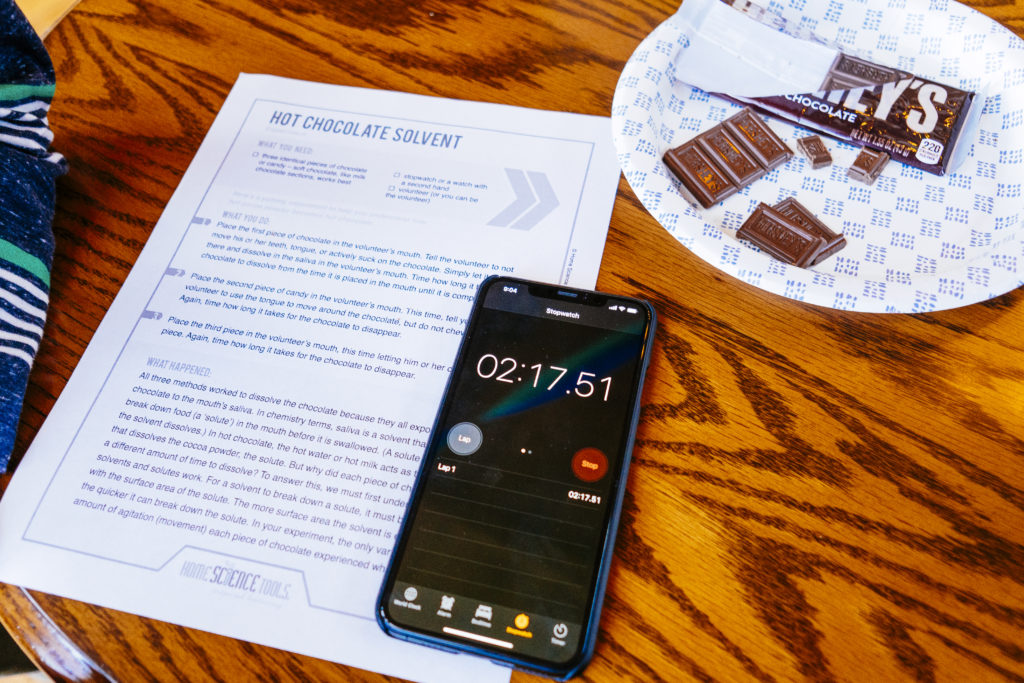
Here’s a yummy experiment to help you understand how hot cocoa powder becomes hot chocolate. You will need three identical pieces of chocolate or candy – soft chocolate, like milk chocolate sections, works best. You will also need a stopwatch or a watch with a second hand, and a volunteer (you can also do this on your own without a volunteer) to dissolve the chocolate.