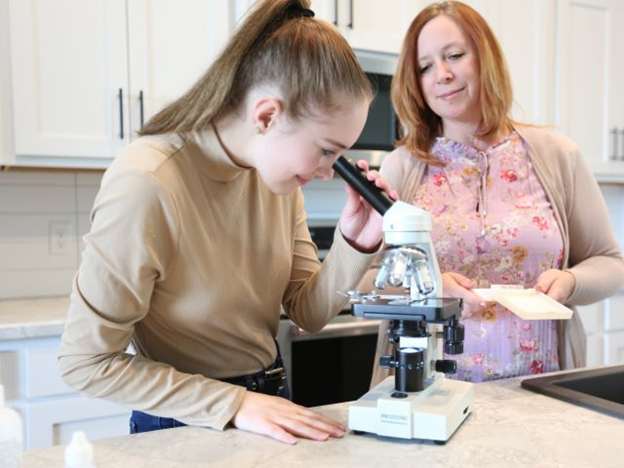
Teaching science at home can feel intimidating at first, not because science is inaccessible, but because many adults were taught it in ways that felt rigid, abstract, or disconnected from real life. Homeschooling gives you a rare advantage: the freedom to teach science as an ongoing process of curiosity, observation, and understanding rather than a checklist of facts. When approached thoughtfully, science becomes one of the most rewarding subjects to homeschool.
This guide is designed to help parents build confidence, choose wisely, and select a well-rounded homeschool science curriculum that is both rigorous and deeply engaging, without turning your home into a classroom or your child into a passive note-taker.
Start with Understanding, Not Memorization
One of the most common mistakes in science education is emphasizing memorization before understanding. Children may be able to recite the parts of a cell or list the planets, but struggle to explain why those things matter or how they relate to the world around them.
In a homeschool environment, you can slow down and focus on foundational concepts. Instead of racing through topics, spend time asking questions like:
- What is actually happening here?
- How do we know this is true?
- What would happen if something changed?
Science becomes far more meaningful when children understand cause and effect, patterns, and systems. A deep grasp of fewer concepts is far more valuable than a shallow exposure to many.
Choose a Reliable and Trusted Homeschool Science Curriculum
A strong homeschool science curriculum is not optional; it is the backbone that ensures your child receives a coherent, accurate, and age-appropriate education. While flexibility is a strength of homeschooling, science still requires structure, progression, and consistency.
A reliable curriculum should:
- Build concepts logically from year to year
- Explain why things work, not just what they are
- Include opportunities for experimentation and observation
- Align with established scientific understanding
- Offer guidance for parents, not just students
Avoid cobbling together random worksheets, videos, and experiments without an underlying framework. While supplemental resources can be helpful, they should support (not replace) a cohesive curriculum. A trusted program, such as the science curricula we offer here at Home Science Tools, provides confidence that nothing essential is being missed and that learning is building toward real scientific literacy.
We recommend browsing our selection of available curricula, which include essentials covering every aspect of science, including earth science curriculum, life science, chemistry, and more.
Emphasize Observation and Inquiry
Science begins with noticing. Before introducing terminology or formal explanations, encourage your child to observe the world closely.
Ask them to:
- Describe what they see, hear, or feel
- Notice patterns over time
- Compare similarities and differences
- Make predictions based on what they’ve observed
When a child learns to pay attention, science becomes intuitive rather than intimidating. Whether watching ice melt, tracking plant growth, or observing shadows change throughout the day, these moments lay the groundwork for scientific thinking.
Importantly, allow space for wrong guesses. Being incorrect is not failure in science; it is part of the process. When children feel safe to speculate, they develop curiosity and resilience.
Make Experiments Purposeful
Hands-on experiments are often seen as the heart of science education, but not all experiments are equally valuable. The goal is not spectacle or entertainment; it is always understanding.
Before starting an experiment, help your child understand:
- What question are we trying to answer?
- What do we expect might happen?
- What variables are involved?
Afterward, discuss:
- What actually happened?
- Why might that be?
- What would we change if we did it again?
Simple experiments done thoughtfully are far more effective than complex ones done without reflection. A glass of water, a flashlight, or a handful of household materials can teach profound scientific principles when approached with intention.

Integrate Science Into Daily Life
One of the greatest advantages of homeschooling is that science doesn’t have to stay confined to a lesson block. Science is already embedded in daily life; you simply need to point it out.
Cooking involves chemistry and measurement. Weather patterns introduce atmospheric science. Gardening explores biology, ecosystems, and soil health. Even household repairs can spark conversations about physics and engineering.
By consistently connecting science to real-world experiences, children learn that science is not a separate subject; it is a way of understanding how the world works.
Adjust Depth and Pace to Your Child
Traditional classrooms often move at a pace dictated by schedules rather than comprehension. Homeschooling allows you to adapt science education to your child’s developmental stage and interests.
Some children thrive on detailed explanations and want to explore topics deeply. Others need time to gradually absorb concepts. Pay attention to when your child is genuinely engaged versus when they are overwhelmed or disengaged.
It is better to pause, revisit, or approach a topic differently than to push forward without understanding. Mastery matters more than speed.
Teach Scientific Thinking, Not Just Scientific Facts
Science education should cultivate a way of thinking, not just a body of knowledge. Encourage habits such as:
- Asking thoughtful questions
- Evaluating evidence
- Distinguishing between observation and opinion
- Understanding uncertainty and probability
These skills are transferable far beyond science. They support critical thinking, problem-solving, and informed decision-making in everyday life.
When children learn how science works, they become capable of navigating new information confidently, even in areas they haven’t formally studied.
Be Honest About What You Don’t Know
Many parents worry that they need to be science experts to homeschool effectively. This is not true. In fact, admitting when you don’t know something models an essential scientific attitude.
When a question arises that you can’t answer, explore it together. Look it up, discuss possibilities, and test ideas when possible. This demonstrates that learning is ongoing and that curiosity does not end with adulthood.
Your role is not to have all the answers; it is to guide the process of discovery.
Our resource center is packed with valuable information, tutorials, and other resources you can use to facilitate this learning process together.
Revisit Concepts Over Time
Science understanding deepens through repetition and revisiting ideas in new contexts. Concepts introduced in simple terms early on can be expanded and refined as your child matures.
For example, a young child might learn that plants need sunlight to grow. Later, they can explore photosynthesis, energy transfer, and ecosystems. Returning to familiar ideas with increasing depth reinforces learning and builds confidence.
A strong homeschool science curriculum will naturally support this spiral of learning, revisiting concepts at appropriate levels.
Create a Calm, Curious Learning Environment
Finally, the emotional environment matters just as much as the academic one. Science should feel inviting, not stressful. Avoid turning lessons into tests of performance or correctness. Encourage curiosity, patience, and thoughtful discussion. Allow time for reflection. Celebrate effort and insight rather than speed or perfection.
When children feel supported and unpressured, they are more likely to engage deeply and develop a lasting interest in science.
Start With the Science Curriculum and Expand From There
With a reliable and trusted homeschool science curriculum, a focus on understanding, and a commitment to curiosity-driven learning, parents can provide an education that is both rigorous and deeply human.
Science taught well does more than explain the world; it teaches children how to think, how to question, and how to wonder. That is a gift that lasts far beyond any single lesson. If you are a homeschool parent looking for a trustworthy homeschool science curriculum, we invite you to explore our store or get in touch with us for more information!