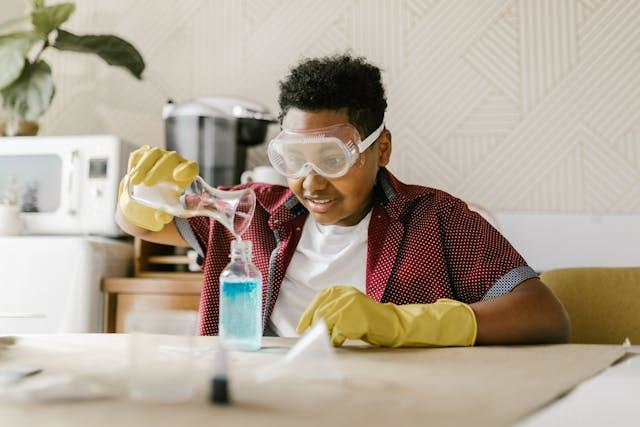
Students who are 14-19 years of age are looking forward to the future. They may be preparing for college or technical school or focusing on simply graduating. This age group is distracted by many outside activities, and, if they are not interested in science, will be a challenge for the teacher. If they are interested in a future in science, they will need quality tools to enable them to learn.
The following tips may help you as you teach high school science.
- Science classes for this age group are usually Biology, Chemistry, and Physics. Ninth grade may be a combination of chemistry and physical science. Providing good reference materials as well as lab equipment is essential to a quality science class for high school. Even students who are not interested in science should be exposed to the basic principles of each of the science areas. They may not perform many experiments, but they will need to see concepts to grasp what is being taught. If a student is not science-oriented, focus on key science principles through experimentation. Colleges like to see science taught all four years of high school.
- Utilize developing math skills and problem-solving. By high school, students’ math skills are highly developed and students can solve many of the problems presented in chemistry and physics. However, these two classes may prove challenging for students who aren’t strong in math. Practicing math problems builds confidence and proficiency; provide extra help when necessary. If, as the teacher, you’re not confident performing the math problems associated with a certain science curriculum, consider a DVD or online course. Problem solving can also be thinking of alternative solutions to problems we face in our world, such as air and water pollution.
- Engage students by asking questions. Critical thinking skills should be highly developed at this age and need to be challenged and stimulated. Ask serious questions about the world, as this age group needs to be engaged and feel connected to science as an interesting and exciting pursuit. Get kids thinking at a deeper level by asking questions, such as: Why are scientists interested in cause and effect? What difference can technology have on the environment? What difference can one person make by recycling?
- Build confidence through experimentation. At the high school level, quality lab equipment is essential for experimentation. And the old adage rings true: Seeing is believing. Observing cells under a microscope suddenly makes cellular structure interesting and real. Viewing stars through a telescope puts our galaxy within reach and makes the heavens more intriguing. A good compound microscope is highly recommended for any student interested in pursuing a science career. Teach proper safety protocol with all science equipment, so students are comfortable and confident using it. Under teacher supervision, allow students to experiment independently or in a small group.
- Make science class fun, relevant, and challenging. The 14-19 year old student may think science is boring. Hands-on experiments, field trips, and interaction with others will help students discover which areas of science interest them. A field trip example is the waste water treatment plant, as students may find learning about how water gets clean interesting. High schoolers are much more capable of design and engineering and STEM is highly relevant for this age group, particularly for students interested in science careers. Encourage STEM (Science, Technology, Engineering, and Math) study as a vehicle for students to develop new designs for the future.
- Alleviate boredom through activity. The high school student who is not interested in science may be challenging. Providing well-suited books on subjects a student finds interesting may help the bored student. Involve these student in setting up experiments and teaching others to help keep them engaged. Whenever possible, encourage independent exploration of topics that of their choosing. Use a multidisciplinary approach (incorporating other academic subjects, such as literature, art, music, or history) with science lessons. An example is writing song lyrics about the science topic they’re studying. For students who enjoy hands-on learning, provide additional projects and experiments. For example, a student interested in photography might be interested also in microphotography (for which this teaching microscope is perfect). An option is an insect, rock, or plant collection that’s carefully labeled. All students may become bored while waiting for experiments to finish, so plan related activities to maintain their focus during waits. Some students also will enjoy reading topical books.
- Encourage skills through the science notebook. During the high school years, the science notebook will be more of a personal science journal, as most experiment data will be recorded in lab books. The science notebook is especially valuable to a student who is experimenting independently or designing a specific object or studying a certain subject in-depth, such as behavior of an animal or a plant’s response to temperature change.
- Encourage independent investigation. Promote scientific thinking through independent study of a specific topic that interests the student. Who knows what a student may discover? A teenager won the Nobel Prize in 1915, and a 13-year-old created nuclear fusion by experimenting. Products that encourage young scientists to discover new and interesting things on their own are an invaluable investment. Examples are a good compound microscope and high-school-level slides for a student interested in biology, a high quality distillation kit for students interested in chemistry, and research books for all areas.
- Develop the mind further through vocabulary. Memorization of vocabulary is helpful in building confidence and understanding. When you ask a question, expect students to respond using scientific jargon. Just as junior high vocabulary prepared students for high school, the memorization of terms at this level prepares students for college.