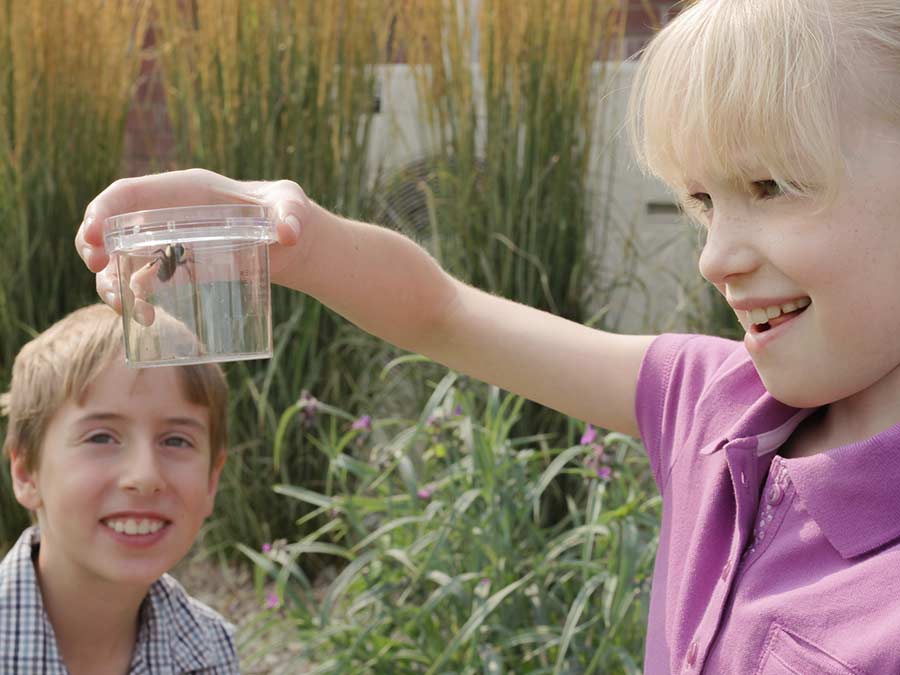
Let’s try a pond science project this summer. Up first:
To collect some specimens, scoop a cup or so of pond water into a jar. Take your sample near plants, as the most specimens will be located there. Preferably, you should observe the sample within 24 hours, as the composition of it will change over time. Also, make sure the specimens have air!
While you are at the pond, you might want to take advantage of the opportunity for a more complete life science study. You can look for animal tracks, identify plants, and look at the insect population. Look carefully at the soft ground around the water for animal tracks. You might find bird or mammal tracks, which can be identified with a guide book. For bird tracks, you might want to have your kids draw what the prints look like.
With the larger animal tracks, you can use plaster of paris and a tin can with both ends cut out to make a cast of the prints. Carefully remove any debris from a track, then firmly press the can into the soil around it. Mix 1/4 to 1/2 a cup of plaster with enough water to make it the consistency of pancake batter. Pour the mixture over the print, until there’s a layer of one inch in the bottom of the can. You’ll need to let the plaster of paris dry for about an hour before you can remove the can, and then for 24 hours until you can remove the cast from the can.
Use a guide book to identify the plants and flowers around the pond. How do the plants around the water differ from those further back, or from the aquatic plants in the water? What shape are the leaves? Be sure to look for interesting features such as berries, seeds, or thorns. Your children might enjoy sketching some of the plants they’ve identified.
There’s usually an abundance of insect life around water. Look at the water first; are there insects on the surface, or hovering around it? How do they move? Do you see different insects further away? (Look under rocks or pieces or wood along the shore.) What about on plants? Use a guide book to identify as many insects as you can. Have your kids sketch some of the different specimens they see; or, if they want to, have them catch insects to be preserved in a collection. You might also find snails, minnows, frogs, snakes, and turtles.
You can observe your pond water sample with either a microscope or a magnifying glass, although some organisms will be visible without magnification (daphnia, hydra, and planaria, for example). Use a dropper to ‘catch’ visible specimens. Most organisms can be viewed without high magnification, but if you want to use a compound microscope, place a drop or two of the water on a clean slide (concave slides work best). You might want to add a drop of methyl cellulose solution to quiet the protozoa in the water, so that you can observe them more easily. Set a coverslip over the section of the slide where you placed the water sample. If you’re using a magnifying glass or a stereo microscope, pour a little of the pond water into a petri dish or other clear, shallow dish and then use the dropper to add specimens.
Use a dichotomous key to identify protozoa and algae, or else a pond identification guide. When trying to identify a specimen, look at specific features: what shape is it? Does it have cilia (tiny hair-like structures) to help it swim? What color is it? Have your children jot these observations down as well.
If you don’t have any pond water available, use our Protozoa Hatchery Kit to grow the sort of specimens you’d find in a pond.