
In this experiment, we will make a homopolar motor! To make a simple motor (homopolar motor) that doubles as a work of art you will need three things – a battery, magnet, and wire. Use one of our neodymium magnets to power the spinning wire motor.
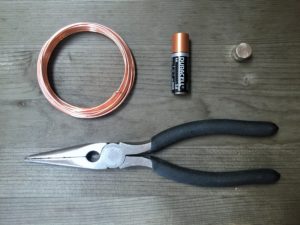 What You Will Need:
- 1 neodymium disc magnet (0.5” diameter, with 0.25” thickness)
- 1 AA battery, 1.5 volt
- Copper wire (not insulated), 14 gauge
- 12” inch ruler
- Needle nose pliers with wire cutter
Note: This project will take some work to get going. The end result is worth it! We recommend this project for ages 12 & up, with adult supervision.
What to Do:
1. To make your wire sculpture, start with a piece of wire 6” long. Make sure your wire is copper, and doesn’t have insulation or a plastic coating. Thick wire (14-16 gauge) works best. Measure 6” of wire using the ruler, then cut it using the wire cutter.
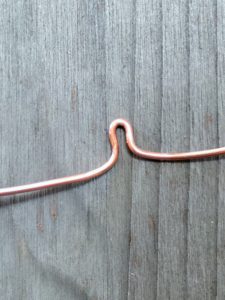
2. Find the middle of the wire using the ruler. Bend the wire into a V at the center, using the pliers. Then, bend each side perpendicular to the V you made.
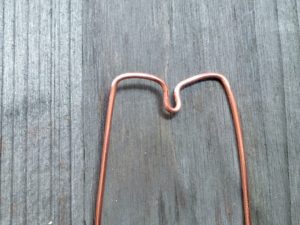
3. Bend each wire end again, so the ends point down. Use the pliers.
4. Lay the wire sculpture on a flat surface. It should lay flat. If it does not, carefully straighten it using the pliers.
5. With the sculpture on a flat surface, hold the battery up to measure its length. Put the positive end of the battery (the side with a bump on it) next to the V of the wire. Note where you would need to bend the ends of the wire so they meet the negative end (flat side) of the battery.
6. Bend the bottom ends of the wire sculpture at an angle using the pliers.
7. Put the neodymium magnet on the flat bottom of the battery. This is the negative end. Stand the magnet and battery upright on a flat surface.
8. Rest the V of the wire on top of the positive side (bump) of the battery. Carefully balance the sculpture, making sure the ends of the wire bent at an angle make contact with the magnet (not the battery).
9. When your wire seems balanced, let go.
10. If the motor doesn’t begin to spin, try flipping the magnet so the other side is touching the battery. If it still doesn’t work you will need to tweak your wire sculpture. Remove the battery from the magnet while you work, so it does not get too hot.
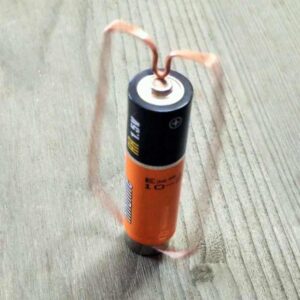
11. To tweak your wire sculpture so it spins keep in mind these things:
- The wire sculpture needs to be balanced in order to spin. Make sure your wire piece is perfectly flat when it is on a flat surface.
- The wire should also be symmetrical. Both sides should be the same. This is why you started your sculpture in the middle of the wire. Try again with a new piece of wire if necessary.
- The ends of the wire should lightly touch the magnet. If it is a tight fit, the motor will get stuck and can’t spin. Just the ends of the wire should be making contact.
What Happened?
You made an electric homopolar motor! The type of current this motor uses is DC or direct current. That means the flow of electricity goes in one direction only. Electricity flows from the positive end of the battery to the negative end.
To complete the circuit, you used a copper wire. Copper is a metal that conducts electricity. Electricity flowed from the positive end of the battery to the negative end. It flowed through the battery, into the wire, up the wire, and back into the positive end of the battery! This is called a complete circuit. Electricity is flowing one way (direct current).
Why did the motor spin? That’s where the magnet comes in. The magnetic field has a positive end and a negative end. The magnetic field is pushing up towards the battery. The electric flow of current is pushing down towards the magnet. These opposing forces cause an outward motion on the wire – causing it to spin around the magnet.
This kind of motor with a battery, magnet, and wire, is called a homopolar motor. Due to the force of magnetism and the flow of electricity, the wire spins one way. This motor won’t be able to power anything, but it’s fun to look at!
Further Experiments:
Now, you can make more elaborate designs using a longer wire. Make sure the wire is balanced. Is there a way to make the motor spin faster? Try using two magnets. Be very careful not to let the battery overheat! When done, carefully separate the wire, battery, and magnet.
Find more exciting STEM projects focused on Electricity & Electronics!