
Year
The Earth travels around the sun. The length of time it takes the Earth to go around the sun once is 365 days, which we call one year.
Day and Night
While the Earth travels around the sun, it also spins, or rotates. When your home on planet Earth is facing the sun, it is daytime. As the Earth rotates away from the sun, you see the sun “go down,” which is really your part of the Earth spinning away from the sun, and you are in darkness, or night for the hours it takes for the Earth to spin back toward the sun. When you are in daytime, people on the other side of the Earth are facing away from the sun, so they are in nighttime.
Seasons
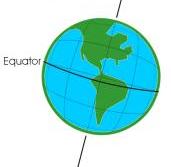 Our seasons are caused by an interesting fact about the Earth: it is tilted on its axis. What does that mean? Imagine a straight stick going up and down through the Earth, and sticking out both ends. Now imagine pushing on the top of the stick so that it is not quite straight up and down anymore. Now it is tipped, or tilted. That is how the Earth is: tilted. As it spins – causing day and night – and orbits the sun, some areas of the Earth tilt toward the sun while other areas of the Earth are tilted away. When your area of the Earth is closer to the sun and its warmth, you are in summer; when your area of the Earth is further away from the sun’s warmth, you are in winter. If your area of the Earth is near the center, or equator, you are always about the same distance from the sun, so your seasons are not as different.
Hours
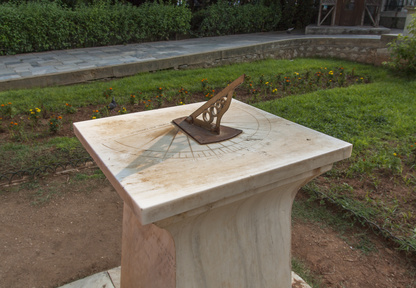
The first type of clock was a sundial, where they could see an object’s shadow move as the sun moved. The object that casts a shadow in the sundial is called a gnomon (Pronounce ‘gnomon’ like ‘Roman’ – but with an ‘n’ at the beginning; the ‘g’ is silent.) You know that the shadows made by the sun move as the hours go by: have you started playing in the shade of a tree and had to move as the shadow moved? Or sat on a beach under an umbrella and had to move to stay in its shadow?
As the Earth spins on its axis, the sun’s rays come to Earth at different angles, which cause the shadows to move. By marking where the shadows land throughout the day, you can see how amounts of time are shown by marking where an object’s shadow has moved.
Make your own sundial to see how this works!
How are the hands on a clock based on the sun?
The people who made the first clocks lived in the northern area of the Earth – the northern hemisphere – where the shadows cast by the sun move from left to right. When they built the first clocks, they made the hands move like the shadows of the sundial moved: from left to right.