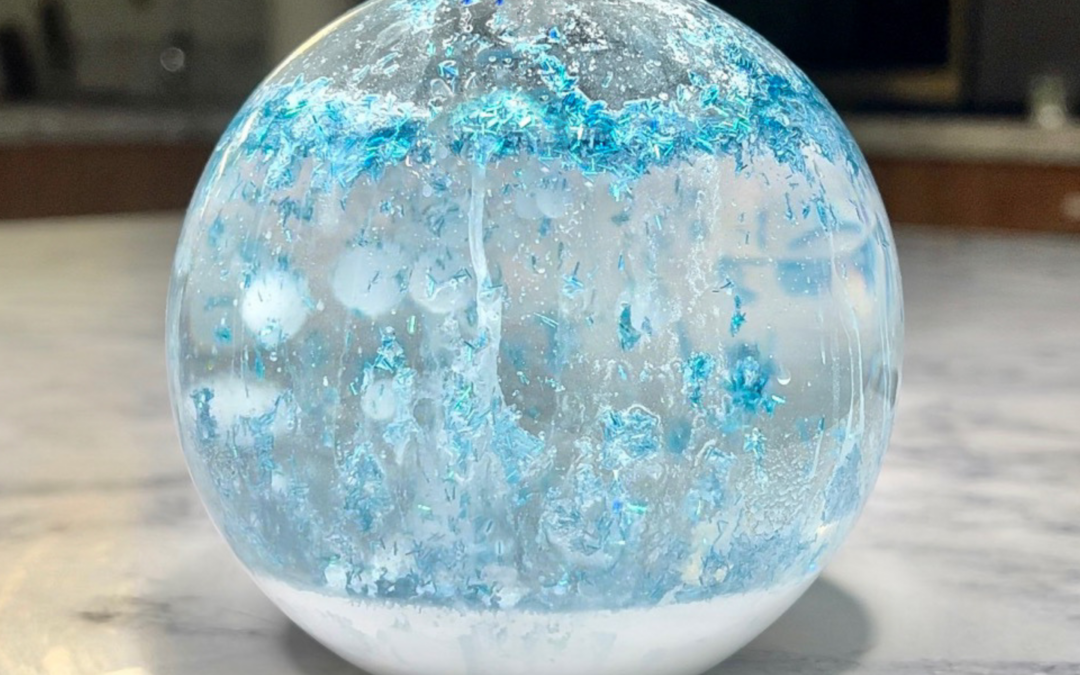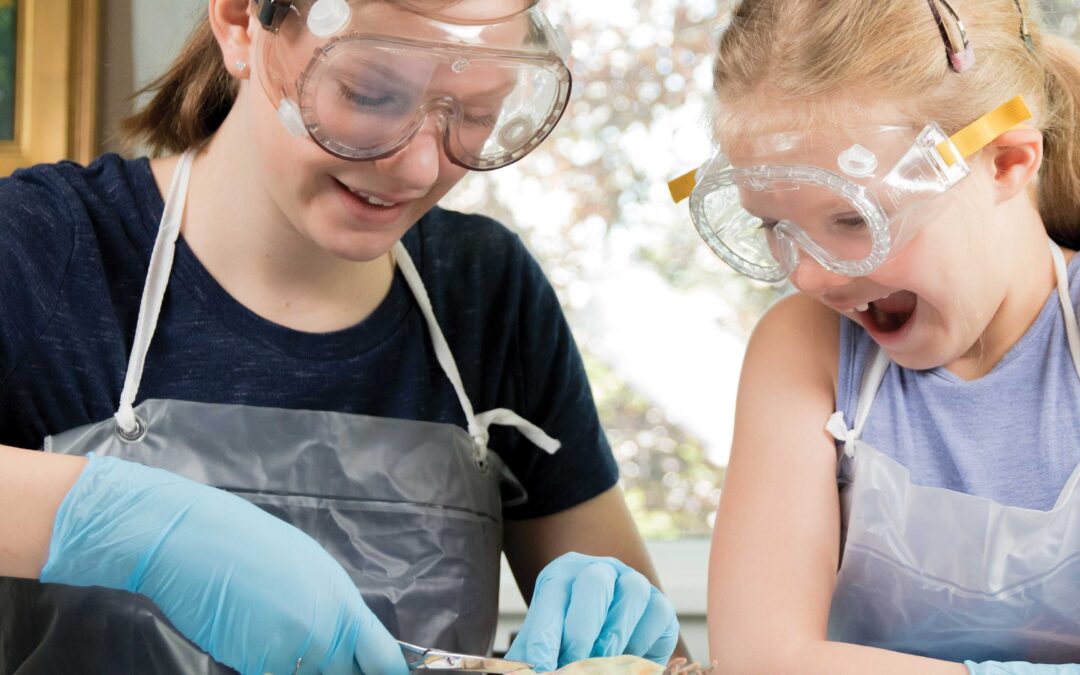
With these DIY Christmas projects—crystal snowflakes and frosted windowpanes—you don’t need snow or freezing temperatures to enjoy a festive white Christmas this year! Use common household items to grow two different types of crystals for a sparkly snowflake ornament and frosted windowpanes that are sure to make your days merry and bright.
Christmas Projects: Crystal Snowflakes & Frosted Windowpanes
You’ve probably seen lots of crystals—even if you don’t know it! Diamonds are crystals, and so are snowflakes. Even salt and sugar are crystals! To make these crystal projects, we’ll first make super-saturated solutions. A solution is a liquid (solvent) with a solid (solute) mixed into it. Our solution is super-saturated because no more of the solid (solute) can be mixed in; it’s reached saturation. Crystals form as a result.
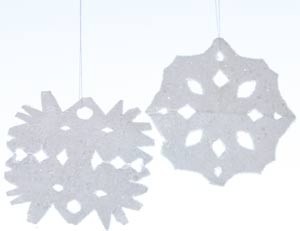
Paper Crystal Snowflakes Ornament Project
What you need to make crystal snowflakes
- Filter paper (or coffee filters)
- Sodium tetraborate (Borax)
- Water
- 600 ml beaker (or another glass container)
- Stirring rod (or spoon)
- Scissors
- Petri dishes (or plate)
- Fishing line (or string)
What to do to make crystal snowflakes
1. Make a supersaturated solution of Borax and water by having an adult help you use the microwave to heat about 200 ml of water until boiling. Use caution when removing the glass from the microwave, because it will be hot! Mix in teaspoons of Borax until no more will dissolve. Allow the solution to cool. If you’re using a petri dish, use it as a template to cut your filter paper (or coffee filter) down to size so it will fit inside. Then, fold the paper in half 2-3 times and snip the edges thinking about where the cuts will appear when you unfold it. You may want to practice on scratch paper first and figure out where to cut to come up with the best snowflake design.
2. Unfold your snowflake and place it in the petri dish (or on the plate). Then, carefully pour the supersaturated solution over the snowflake, making sure it’s completely immersed.
3. Let the crystal snowflakes sit in the solution for an hour or longer until it’s covered in crystals. Then, pour off the solution and use a butter knife to carefully remove the snowflake. Place it on paper towels to dry. You may need to use a toothpick to knock crystals out of the snowflake’s holes.
4. Once it’s dry, feed fishing line or string through the snowflake and hang your ornament on your tree. Or if it’s a gift, wrap it up for Christmas!
Frosted Windowpanes Science Project
What you need to make frosted windowpanes
- Magnesium sulfate (Epsom salt), 75 grams (1/3 cup)
- Liquid dishwashing soap, 1-2 drops
- Water, 125 ml (1/2) cup
- Lens cleaning cloth (or similar high-density cloth)
- 600 ml beaker (or another glass container)
- Stirring rod (or spoon)
What to do to make frosted windowpanes
1. Begin by making a supersaturated solution by stirring the Epsom salt (solute) into warm tap water (solvent) inside the beaker. If the salt doesn’t dissolve completely, then have an adult help you microwave it for about 30 seconds. Afterward, carefully remove it, and stir it again.
2. Next, add the dishwashing soap. Then, stir again.
3. Use the lens cloth to “wash” the solution onto a glass window or mirror. Dab away the excess to avoid drips.
4. Let it dry. Finally, enjoy your homemade “frost!”
Tips: Try dipping a glass votive holder in the solution, then inverting it to dry. For windows, wetter is better and creates a more natural-looking frost. But drips give it away, so be careful. To remove the frost, simply wipe the surface down with water. If you have a magnifying glass, use it to examine your frost crystals up close.
Science Words
Saturation — when no more of something can be absorbed, combined with or added.
Solute — any solid substance dissolved in a liquid solvent to form a solution.
Solution — when a solid dissolves in a liquid and they’re evenly mixed together. Salt water is a solution of salt and water. A solution can also be liquids mixed together.
Solvent — a liquid capable of dissolving a solid substance (called a solute) and creating a liquid solution.