
What do you know about the lungs?
Although they breathe for us, keeping us alive, the process is mostly involuntarily.
Therefore, most of us don’t give much thought to these important organs.
Read on to learn how to construct a lung model using common household items.
Getting Started
What You Need:
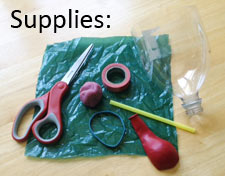
- empty 2-liter bottle
- plastic bag (trash bag or thick grocery bag)
- thick rubber band
- balloon
- drinking straw
- masking tape
- modeling clay
- scissors
- an adult to help
Build a Lung Model Step-by-Step
What You Do:
1. Have an adult help you cut the 2-liter bottle in half; you will only use the top part; discard the bottom and the bottle cap.
2. Cut a square of plastic from the bag. Make it big enough to cover the large opening of the cut bottle (about 8”). Don’t worry about getting the edges perfectly straight!
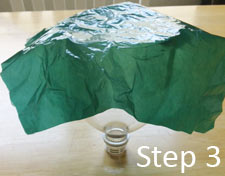
3. Stand the bottle top on the table and place the sheet of plastic over the large opening, use a large rubber band to secure it around the bottle. Gently pull the edges of the plastic, so it is tight across the top.
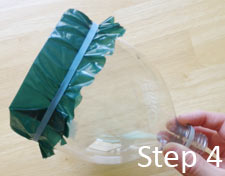
4. Cut off the excess plastic next to the rubber band.
5. Put the straw into the balloon and seal the opening around the straw with several pieces of tape. Blow gently on the end of the straw to make sure air goes into the balloon. If the balloon doesn’t puff out a little, seal it around the straw better so air cannot escape.
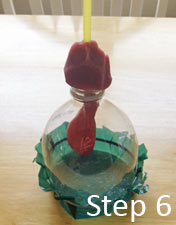
6. Put the balloon end into the bottle’s opening and use modeling clay to secure the straw to the bottle so that air can only pass through the straw.
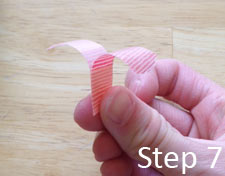
7. Fold a piece of tape in half with sticky sides together leaving the ends exposed (only stick the tape together in the middle). Attach the sticky ends to the bottom of the plastic.
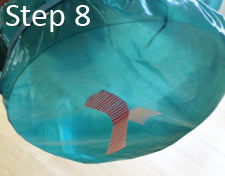
8. Use the tape tab as a handle and gently pull down slightly on the plastic and watch what happens to the balloon. Now push up gently while watching the balloon.
What Happened:
The contraption you built is a model of how your lungs work! The plastic at the bottom works like your diaphragm—a strong muscle that expands and contracts to cause your lungs to fill with air and then empty out again. The movement of the balloon matches your breathing – when you breathe in, your lungs fill with air just like the balloon did. That’s because the diaphragm expanded making room for air to get in through the straw (which represents your airway, or trachea). When you breathe out, your diaphragm contracts (or squeezes in) pushing all the air out of your lungs.
The same thing happened in your soda bottle model – when you pulled down on the plastic, the balloon inflated slightly and when you pushed up, the balloon deflated! Inside your body, you have two lungs that work together, and the diaphragm is below them. Air goes in and out of both of your lungs at the same time. This model just represents one lung.
Read More
Click here to read a brief science lesson explaining how lungs work.