The Science Behind Amusement Park Physics
Amusement park physics is all around you—every twist, drop, and spin shows off the laws of motion, energy, and gravity in action.
Amusement parks are thrilling places to spend the long days of summer, but did you know that these parks are also huge physics classrooms?
Engineers build all the rides with the laws of physics in mind, and playing with these laws makes the rides so fun and scary.
We’ll take a look at four of the most common types of rides to see how the forces, energy types, and laws of physics are at work in amusement parks.
Examples of Amusement Park Physics in Action
From bumper cars to roller coasters, each ride in the park demonstrates unique laws and forces. Let’s explore how amusement park physics brings these rides to life.
Amusement Park Physics
- Bumper Cars: Newton’s Three Laws of Motion
- Carousel: Centripetal Force
- Free Fall: Potential Energy, Kinetic Energy, and Gravity
- Roller Coaster: Putting It All Together
Bumper Cars: Newton’s Three Laws of Motion
Bumper cars are a great place to see Sir Isaac Newton’s three laws of motion in action. Here’s how:
Newton’s First Law: Inertia in Motion
Newton’s First Law: Every object in motion continues in motion and every object at rest continues to be at rest unless an outside force acts upon it.
This is because all objects have inertia – the property of matter that resists changes to the object’s motion.
Newton found that if a ball is sitting on a table, it will stay sitting there because that is what it ‘wants’ to do.
When you set the ball in motion, it keeps traveling in a straight path because that’s what it ‘wants’ to do.
An object in motion will not stop, slow down, or change its direction unless an outside force acts on it (such as gravity, friction, and air resistance).
When you are riding in a bumper car and end up in a collision with another bumper car, you feel a jolt. This is because your body’s inertia wants it to keep traveling in the direction it was moving with the car even though your bumper car has now suddenly stopped.
Newton’s Second Law: Force, Mass, and Acceleration
Newton’s Second Law: The greater the mass of an object, the harder it is to change its speed.
(More force is needed to move it.)
You already know this law and practice it in your everyday life. Something that is small, such as a pebble, is much easier to pick up and throw than something that is large and heavy, such as a boulder.
When you ride the bumper cars, you may notice that lighter people get pushed around more than heavier people.
The more mass (weight) an object has, the more force it takes to move it.
And since all the bumper cars usually have the same top velocity, the cars carrying more mass will never travel as far as the cars carrying less mass after a collision.
Newton’s Third Law: Action and Reaction
Newton’s Third Law: For every action, there is an equal and opposite reaction.
When two bumper cars of equal speed and weight collide, they bounce off and move equal distances apart.
Based on the second law, if the two cars have different weights, the lighter car will move farther after impact. The heavier car won’t travel as far.
Click to learn more about Newton’s Three Laws of Motion.
Carousel: Centripetal Force
Imagine spinning a ball on a string around you.
The ball is traveling in a circular path. Newton’s first law says an object in motion stays in motion. It moves in a straight line, not a circle.
Since the ball is traveling in a circular path, an outside force must be acting on the ball. That force is the string. The string is pulling the ball back toward you, acting as the centripetal force.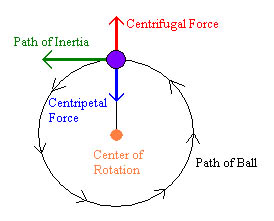
Centripetal means ‘center-seeking’ and is the force that is acting on the carousel.
The platform with the horses and riders acts as the centripetal force. It keeps them moving in a circular path like the string does for the ball.
If the ride moves slowly enough, the platform’s centripetal force holds everyone on board. This force keeps riders safely in place.
What Really Happens When You Spin Fast
If the carousel moves very fast, centrifugal force (‘center-fearing’) takes over. It breaks the platform’s hold, and riders could fly off.
*Centrifugal force is actually not a real force. If the centripetal force stops (like the string breaking), the object’s inertia takes over. It then moves in a straight path.
You can test this outside by spinning a ball around you and letting go of the string. If centrifugal force were real, the ball would move straight away from the center. This would happen when the string is released.
But it doesn’t. Instead, the ball follows its inertia. It moves in a straight line tangent to the circle. The carousel is a classic example of amusement park physics. It shows how centripetal acceleration creates circular motion.
Free Fall: Potential Energy, Kinetic Energy, and Gravity
In free fall rides, motors lift the car and passengers to the top of a tower. This builds potential energy as they reach the top.
Potential energy stores energy and can become working energy.
When the car releases, it converts potential energy into kinetic energy. Gravity pulls the car and passengers back down to Earth.
However, no matter what an object weighs, all objects fall at the same rate. So, both you and the car are falling at the same speed, giving you the feeling of weightlessness.
Understanding the Feeling of Free Fall
You may think the car is falling faster than normal. However, gravity is the only force acting on the car. The ride makers are not using motors to accelerate its descent.
After all, you saw and felt yourself pressed against the bars and straps. This happens as soon as the car drops.
But remember that your body has inertia and wants to stay at rest, as does the car you are sitting in.
The mechanism suspending the car at the top of the tower is holding the car, not you. The car is holding you.
So when the mechanism that is suspending the car lets go, there is a slight delay of your body falling with the car because your body’s inertia wants to keep it at rest.
If the same mechanism dropped you and the car at the same time, there would be no delay of your body falling in comparison with the car.
*Although all objects fall at the same rate regardless of weight or size, air resistance affects some objects more than others. Because of their spherical shape, balls allow air to pass easily through them, with minimal air resistance to slow them down. Feathers and parachutes capture air as they fall, which effectively slows them down. In a vacuum, all objects fall at the same speed, as there is no effect of air resistance.
Roller Coaster: Putting It All Together
Roller coasters are the perfect place to see all these laws, forces, and energies at work!
They are not powered by motors the entire way along the ride.
In fact, most roller coasters are only pulled up to the top of the first hill – the highest point of the entire ride. Its entire trip relies solely on the potential energy it has gained by its position at the top of this hill.
The higher a roller coaster climbs a hill, the greater a distance there is for gravity to pull it down. When the roller coaster comes down the hill, its potential energy is converted into kinetic energy.
When the coaster moves down a hill and starts its way up a new hill, the kinetic energy changes back to potential energy until it is released again when the coaster travels down the hill it just climbed.
Feeling the Forces: Gravity, Inertia, and G-Forces
Gravity and inertia are big players when it comes to how you experience the ride.
The force of gravity is measured in g-forces. Most of the time, you are experiencing 1 g, the normal force gravity exerts on you.
However, motion can change how you experience the force of gravity. When the cars are traveling up the hills, you feel heavier because your inertia wants you to stay behind and more g-forces are exerted on you.
So, if a ride states that it exerts 3 g-forces, then you will feel like you weigh 3 times more than you really do while riding on the ride.
Alternatively, when the car travels down the hills, you feel weightless because you are falling with the car and are experiencing 0 g-forces.
When loops and twists are built in the track, the track becomes the centripetal force that keeps the cars and passengers moving in a circular motion.
The inertia of the passengers, which wants them to travel in a straight line, makes the passengers feel like they are being ‘pressed’ into their seats while traveling through the loop.
When a coaster goes up a loop or hill, it must come down, because for every action, there is an equal and opposite reaction.
And if there is not enough force or speed to overcome its mass, a roller coaster cannot make its way through the entire course of its track.
More Physics Activities:
Roller coasters are perhaps the most thrilling demonstration of amusement park physics, combining gravity, inertia, and energy conversion. Want to keep exploring the fun side of physics? Try these hands-on activities that turn motion and energy into excitement: