Often, memories of dense textbooks and complicated formulas come to mind whenever someone says the word “chemistry”. Thus, teaching it at home to a middle schooler can seem particularly daunting. In truth, though, chemistry at this age is less about memorizing the periodic table and more about learning how the world works. When approached with curiosity and a bit of creativity, chemistry can become a subject that feels alive, practical, and even fun.
In fact, this stage is perfect for planting the seeds of scientific thinking. Kids between the ages of 11 and 14 are naturally curious, love asking “why”, and are capable of understanding cause-and-effect relationships. Chemistry, therefore, fits beautifully into that mindset, especially when it’s presented in a way that connects to everyday life. Here’s how to teach it at home:
Start With Everyday Chemistry Concepts
Starting with what your child already knows is by far the easiest way to introduce chemistry at home. Cooking, cleaning, and even breathing are full of chemical processes. When you bake bread, and it rises, you’re watching a chemical reaction. When ice melts into water, you’re seeing a physical change. These moments provide natural entry points into chemical thinking without making it feel like a formal lesson.
Try starting with observations instead of definitions. Ask your child what they notice when you mix vinegar with baking soda, or why metal rusts over time. Curiosity opens the door, and explanations can follow naturally. This approach will help chemistry feel relevant rather than abstract, which is key at the middle school level.
Make Simple Experiments Part of Learning
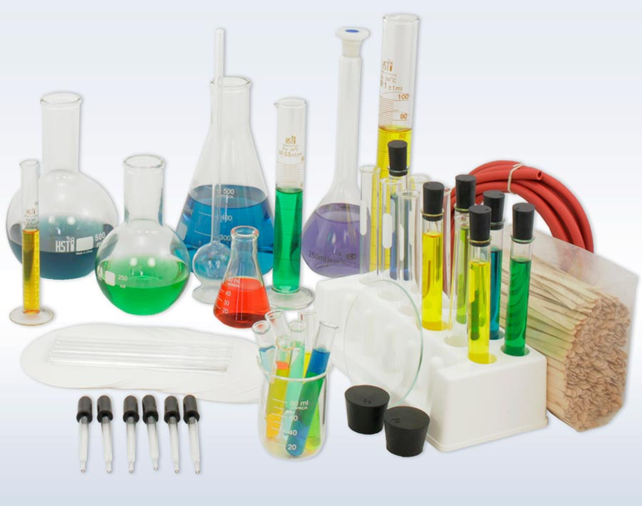
The heart of chemistry, especially for kids, is hands-on learning. However, there’s no need to turn a corner of your home into a laboratory or purchase expensive equipment to run meaningful experiments. Safe, simple activities utilizing household items can demonstrate big ideas like reactions, states of matter, and density.
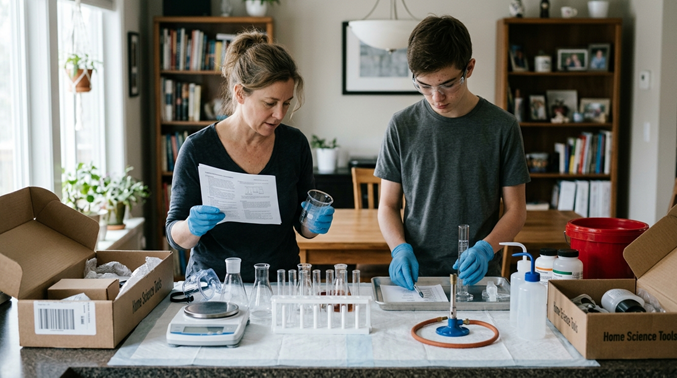
Letting your child participate fully is what matters most here. Measuring, pouring, predicting outcomes, and discussing results all build confidence and understanding. Mistakes are also part of the process, and they often lead to the best conversations. So when something doesn’t go as expected, treat it as an opportunity to talk about variables and why scientists repeat experiments.
Focus on Understanding, Not Memorization
Middle school chemistry should never feel like a race to memorize formulas. At this stage, the goal is to understand concepts, not master technical details. Ideas like atoms being building blocks, substances having properties, and reactions causing change are far more important than solving chemical equations.
Encourage your child to explain concepts in their own words. When they can describe what happened during an experiment and why they think it happened, they’re learning real chemistry already. This approach builds critical thinking skills and lays a strong foundation for more advanced science later on.
Use a Homeschool Chemistry Curriculum for Structure
While exploration and experimentation are important, having structure helps keep learning consistent and progressive. Following an age-appropriate homeschool chemistry curriculum can provide a framework without taking away flexibility. A good one introduces topics gradually, builds on previous knowledge, and includes hands-on activities that match your child’s level.
Here at Home Science Tools, we carry homeschool chemistry programs designed specifically for middle school students. They focus on conceptual learning rather than heavy math and include experiments, discussion prompts, and real-world examples that make chemistry more approachable. If you aren’t very confident in teaching chemistry or it isn’t your strongest subject, using a curriculum can also help.
What’s important is to use the curriculum as a guide, not a rigid book of rules. If a topic sparks extra interest in your child, don’t be afraid to spend more time on it. If something feels confusing to them, slow down or revisit it at a later time. Homeschooling allows for that kind of flexibility, which is a huge advantage.
Encourage Questions and Curiosity
Chemistry thrives on questions. Why did that happen? What would change if we used something else? What do you think will happen next time? Conversations around these questions are just as important as the experiments themselves.
Let your child know that not knowing the answer is okay and looking things up together models how scientists actually work. It also shows that learning is a lifelong process, not something that ends when the lessons are over. Kids that feel safe asking questions are more engaged and become more confident in their abilities.
When chemistry feels safe, engaging, and connected to everyday life, middle school students are far more likely to enjoy it. With curiosity, hands-on experiences, and the support of a homeschool chemistry curriculum, you can turn chemistry into one of the most interesting subjects in your home.