When it comes to hands-on science, geology activities for kids are some of the easiest (and most fun) to start with. After all, rocks are everywhere, free to collect, and full of hidden stories! Surprisingly, an ordinary pebble in your driveway might be millions of years old. As a result, kids love learning that everyday objects can be ancient treasures!
What Do Geologists Do?
Geologists are like Earth detectives. Specifically, they study rocks, minerals, and the natural processes that shape our planet. In fact, from tiny crystals to massive mountains, geologists help us understand how the Earth formed and how it’s always changing.
Skills Your Child Will Develop Through Geology Activities
Through these fun geology activities for kids, your child will build several skills:
- They’ll garner observation and classification skills
- Then, they’ll gain a strong understanding of natural processes and earth cycles
- In addition, they will learn spatial reasoning and pattern recognition
- Also, they will gain knowledge of material properties and scientific testing
Fun and Easy Geology Activities for Kids
1. Start a Rock Collection
Above all, this is one of the best introductory geology activities for kids! Not only is it hands-on and open-ended, but it builds curiosity every time your child finds a new rock.
What You Need:
- Small containers (egg cartons, ice cube trays, etc.)
- Labels or masking tape
- Magnifying glass
- Notebook or science journal
Instructions:
- Collect interesting rocks from your yard or neighborhood.
- Then, wash each rock gently with water and a brush.
- Observe color, texture, and visible minerals with a magnifying glass.
- Then, label and organize by type, location, or color.
- Finally, record findings in a notebook.
2. Create a Sedimentary Layer Model
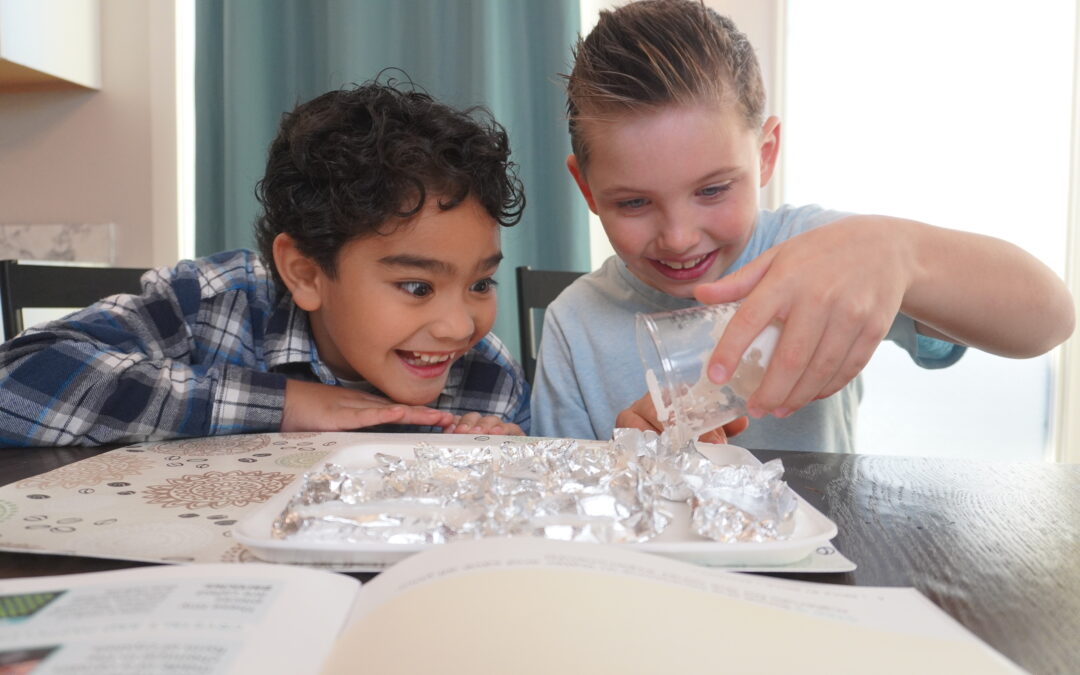
In this simple science experiment, you will learn about sedimentary rocks, specifically how they form over time.
What You Need:
- Clear plastic cup or jar
- Layers of sand, soil, or crushed chalk
- Small pebbles
- Water
Instructions:
- Layer sand, soil, and pebbles in the container.
- Then, pour water slowly down the side.
- Finally, watch how layers settle, simulating real sedimentary rock formation.
- (Optional) In addition, you can compact layers and compare to real sedimentary rocks.
This hands-on geology activity helps kids visualize Earth’s layers. In addition, this activity helps kids learn how geologists read rock formations.
3. Grow Your Own Crystals
Crystals are beautiful and a great way to explain mineral formation.
What You Need:
- Borax powder
- Hot water (adult supervision required)
- Wide-mouth jar
- Pipe cleaners
- String and pencil
Instructions:
- Dissolve 3 tbsp Borax in 1 cup hot water.
- Then, shape pipe cleaner and hang in the jar using pencil and string.
- Let it sit overnight; watch crystals grow.
- Finally, remove and dry.
This is a great way to connect geology to everyday chemistry and natural processes.
4. Erosion in Action: One of the Best Geology Activities for Kids
Show kids how water changes the landscape with this erosion experiment.
What You Need:
- Tray or large pan
- Sand, soil, and pebbles
- Watering can or spray bottle
- Pitcher of water
- (Optional) Small rocks, toy houses, plant materials
Instructions:
- Build a landscape with hills and valleys.
- Then, predict what will happen when water flows across it.
- Simulate rain with the watering can or pour water for river flow.
- Observe erosion, sediment movement, and landscape changes.
- Finally, try erosion control using small barriers or plants.
Without a doubt, this is one of the most engaging geology activities for kids, demonstrating erosion and environmental science in action.
Key Vocabulary for Young Geologists
- Mineral: A naturally occurring solid with a specific chemical structure
- Rock cycle: The continuous transformation of rocks through erosion, melting, and pressure
- Igneous: Rocks formed from cooled magma or lava
- Sedimentary: Rocks formed by compressed sediment layers
- Metamorphic: Rocks changed by heat and pressure

These geology activities for kids offer fun, meaningful ways to explore Earth science through play and discovery. Whether you’re collecting rocks or watching erosion in action, each project builds knowledge and a lifelong appreciation for the wonders of our planet.