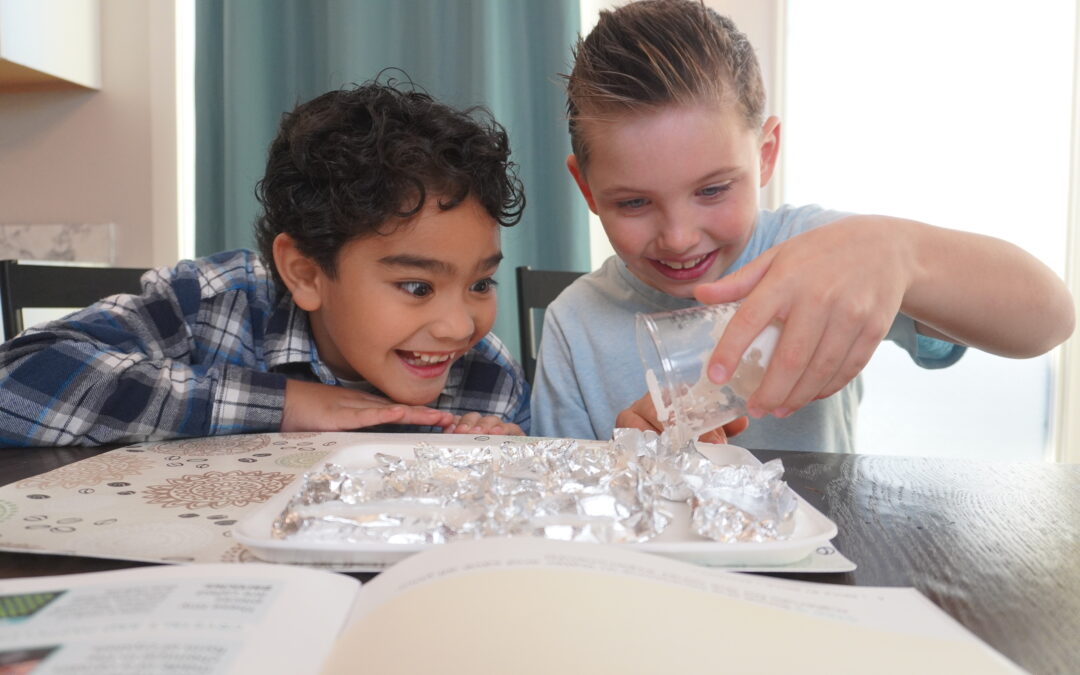
With the slime bubbles science project, you can discover a polymer’s qualities—flexible, stretchy, and pliable! But what is a polymer? A polymer is a long chain of hundreds or thousands of tiny molecules linked together. The slime you make in that project is an interesting type of polymer that is stretchy but can also break if you pull it quickly. You can form it into a ball, but it will eventually flatten out, acting almost like a liquid.
With the water beads project, you can learn about another type of polymer that’s unique because of its superabsorbency. Absorption is the process in which one things soaks up another. This type of polymer is the same kind used in disposable diapers! But unlike these round polymer beads, the kind in diapers is in powder form. Water beads are also popular for use in floral arrangements and planting soil.
There are many different types of polymers in our world. Some are natural and some are synthetic (made by humans). The slime you made was stretchy and flexible, but polymers can also be hard and solid. Here are a few examples of polymers. Can you think of more?
- Gelatin is a natural polymer used in foods and other items for thickening and bonding as well as providing flexibility (for example, it’s used in paper money as well as in baked goods!).
- Plastic is one of the most common polymers. There are lots of different types of plastics that have very different properties – some plastics are flexible and can be bent (like a plastic bag or a toothpaste tube) and some are very solid and would split or crack if you tried to bend them (like a plastic plate or a CD). Fabric such as rayon, nylon, and polyester are synthetic materials that are used for making clothes such as shirts, sweaters, and socks.
- One of the most important natural polymers is DNA, the protein in your cells that makes you who you are!
- Cotton, silk, rubber, paper, and leather are a few polymers from natural sources.
- Rubber comes from a very natural source—a plant! Before it can be used though, it has to be processed (learn more about that below).
So what makes a polymer a polymer? The Greek word poly means “many” and the suffix mer means “parts,” so very simply, a polymer is a group or chain of many of the same “parts” or molecules connected together. Have you ever heard of a monomer? Mono means “one,” so as you might be able to guess, a monomer refers to just one type of molecules that are not grouped together. When thousands of monomers link themselves together, they become a polymer! You can think of a polymer as a being like a bowl of cooked spaghetti noodles—long chains or strings of a substance that can move around each other freely.
Cross-Linking
Sometimes in order to change the behavior of a polymer or to make it stronger, more solid, etc., it may be cross-linked with another substance. When cross-linking happens, those spaghetti-noodle-like chains of polymers are joined to each other making them all one substance. If you were to try to pick up just one, you’d get the whole blob of them all stuck together! That’s exactly what happened to the liquid glue in the slime science project when you added starch to it; its chains became linked together by the addition of the starch and it became one blob that you could pick up. It began to behave more like a solid than a liquid at that point since the chains of polymers were not able to move around as freely. Some examples of cross-linked polymers are vulcanized rubber, Formica (a durable plastic laminate used for things like flooring and counters), water beads, water crystals, and water gel powder, and epoxy (a very strong plastic-like adhesive).