Next to selecting a microscope, a balance is the largest science equipment purchase decision that most schools and homeschool families make.
Watch this video to learn more about digital balances:
The type of balance you need depends on the age of your children and which science curriculum you’re using. Below are some of your options for the primary and high school grades.
Balances for the Primary Grades:
 In the elementary grades, the primary double-pan balance, with 1 gram sensitivity, is ideal. This balance helps children clearly visualize the concept of ‘equal mass.’ (You’ll need to purchase a mass set of some type with this balance.)
Digital scales are an easy-to-use option, although your kids will not see how ‘equal mass’ (when the pans balance) works. The 2000 g digital balance is the best all-around choice. It has a high capacity (2000 grams) and is accurate to 0.1 gram.
A simple spring scale or platform scale will also work for many needs, although the sensitivity of these scales is weak compared to a balance. Use a plastic bag to hang an object from the hook of a spring scale in order to weigh it.
Balances for High School:
For high school chemistry, a balance with sensitivity of 0.1 gram or 0.01 gram is needed to weigh chemicals. A less sensitive balance, like those listed above, is usually adequate for most other high school applications (such as physics).
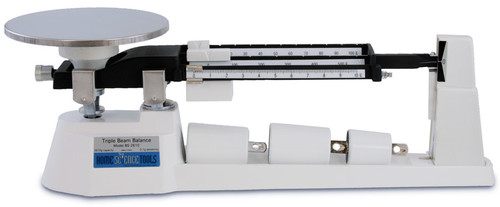 A triple-beam balance is the best all-around mechanical balance with good sensitivity and high capacity. It is easy to use, even for younger children. Order model BS-2610 for the best all-around use.
A digital scale is much faster and easier to use than a mechanical balance for weighing out small amounts of chemicals for chemistry. A 200 g digital balance with 0.01 gram accuracy will work for most labs. For physics, a high-capacity 2000 g digital balance will work well. A wide variety of digital balances are available from Home Science Tools – find one that best fits your budget and lab needs.