Science Projects > Life Science Projects > Blood & the Circulatory System 

Blood & the Circulatory System

Did you know that blood contains more than just blood cells? Our bloodstreams carry red blood cells, white blood cells, platelets, and plasma. Red blood cells, or erythrocytes, carry oxygen through the body and make up a little over 44% of our blood content. White blood cells, which are part of the immune system, fight disease by attacking and devouring harmful cells. Platelets initiate blood clotting by pinching together damaged arteries. White blood cells and platelets together make up less than 1% of our blood. Liquid plasma, which makes up 55% of our blood, carries nutrients to the rest of the body.

Veins carry deoxygenated blood to the heart, and arteries carry blood out from the heart. Tiny capillaries connect veins and arteries to body tissues. Arteries have thick cell walls and are tough and elastic in construction, to deal with the pressure of the blood being pumped through them. Veins have thinner walls and are not as elastic.

Human hearts have four chambers. Deoxygenated blood—which needs a fresh supply of oxygen—is brought into the first chamber, the right atrium. The blood is pumped into the right ventricle, and from there it is pumped to the lungs. In the lungs, the blood receives oxygen. From the lungs, the oxygenated blood is brought back to the heart. The blood passes through the left atrium into the left ventricle, and from there it is pumped through the rest of the body.

Body —> right atrium—> right ventricle —> lungs —> left atrium —> left ventricle —> body</font face>
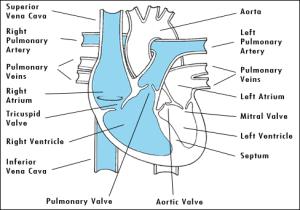
Graphic used with permission from www.advocatehealth.com.

To measure your pulse rate, place your second and third fingers over your wrist on the palm side, in the slight depression beneath your thumb. Gently move your fingers up and down until you find the pulse. You shouldn’t have to push down on your wrist. Count the number of beats that you feel in one minute’s time.

Measure the pulse rates of your children while they are resting. Then measure their pulse rates again after each has exercised for one minute and then ten minutes. Compare the results and explain that exercise increases the body’s demand for oxygen, which results in increased heart and pulse rates.

Find your blood type with one of our easy kits: Blood Type Lab Kit, individual Blood Type test kit, and the Erycard Blood Test Kit.

Teaching Homeschool

Welcome! After you finish this article, we invite you to read other articles to assist you in teaching science at home on the Resource Center, which consists of hundreds of free science articles!

Shop for Science Supplies!

Home Science Tools offers a wide variety of science products and kits. Find affordable beakers, dissection supplies, chemicals, microscopes, and everything else you need to teach science for all ages!

Related Articles

Fun Science Activities to Try at Home With a Digital Microscope

Fun Science Activities to Try at Home With a Digital Microscope

Science activities at home can turn ordinary afternoons into memorable learning experiences. A digital microscope gives children and families a chance to explore details that are impossible to see with the naked eye. From plant cells to fabric fibers, small...

Microscopes for Kids and the Joy of Hands-On Science

Microscopes for Kids and the Joy of Hands-On Science

Science often becomes more exciting when children can see tiny details with their own eyes. A microscope turns ordinary objects into fascinating discoveries, helping young learners explore cells, insects, crystals, fabrics, and plant structures in close detail. At...

Exploring the Night Sky with a Telescope for Kids

Exploring the Night Sky with a Telescope for Kids

A telescope for kids introduces astronomy through direct observation and simple experiments. It supports curiosity about stars, planets, and distant objects while building patience and focus. At Home Science Tools, our goal is to connect scientific ideas...

How Light Moves: A DIY Periscope Experiment 

How Light Moves: A DIY Periscope Experiment 

This DIY periscope experiment helps students understand how light works by giving them something they can actually use. Some science concepts make more sense when students can interact with them directly. With Science Unlocked® full-year curriculum, they build tools...

Changing Ratios: A Balloon Reaction Experiment 

Changing Ratios: A Balloon Reaction Experiment 

In this balloon reaction experiment, students test how changing the amount of baking soda affects how much each balloon inflates. This experiment is part of a Science Unlocked® curriculum, which leads students to observe reactions and test how different amounts...

should I learn computer coding