
Cells are “building blocks” of life: all living things, whether plants, animals, people, or tiny microscopic organisms, are made up of cells. Although a cell is only about 10 micrometers across (one micrometer=one millionth of a meter!), there is still amazing complexity within it.
Cell Anatomy (Starting from the Outside)
The plasma membrane around the cell is semi-permeable, meaning that some substances are able to enter the cell through it and some are not. Plant cells and some bacteria and algae cells have a protective cell wall in addition. Although animal cells don’t have a cell wall, they are protected by other cells, such as white blood cells that fight disease.
Inside the cell is a jelly-like fluid called cytoplasm that holds a cell’s organelles, special structures that perform specific cell functions. Some of the main organelles within the cell are the vacuoles, mitochondria, lysosomes, ribosomes, endoplasmic reticulum, Golgi apparatus, and cell nucleus. Think of organelles as being similar to the organs in your body: your heart, liver, and brain are all organs, performing specific functions to make your body work.
Most of these organelles are present in both animal and plant cells.
The endoplasmic reticulum (ER) is important in the production or synthesis of cell components. Smooth ER produces lipids and membrane proteins, while rough ER (so called because it contains protein-producing ribosomes) produces all other proteins needed by the cell.
These proteins are modified by the Golgi apparatus, which also stores and packages them for exportation from the cell. (You can think of the Golgi apparatus as a kind of shipping department in the cell.)
Vacuolesare the cell’s main storage units, holding food, water, or waste until it can be used or disposed of.
Mitochondria are the “powerhouses” of the cell, converting nutrients to energy. Animal cells contain lysosomes that are responsible for the reactions that break down proteins, poly- and disaccharides, and some lipids. Your white blood cells use lysosomes to “eat” disease with digestive enzymes.
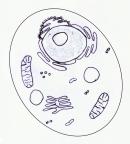
The nucleus provides the “brains” for this operation—the cell would be unable to do anything without it.
The nucleus contains deoxyribonucleic acid, or DNA, which is the genetic material of life. Messenger ribonucleic acid, or RNA, is also important, as is makes a “negative” copy (like the negative of a photograph) of the DNA and takes this information outside the nucleus to the ribosomes.
At the ribosomes, transfer RNA “translates” the code from the messenger RNA, allowing the ribosomes to form protein.
Eukaryotic cells, which include animal and plant cells, have a nucleus enclosed in membrane. Prokaryotic cells such as bacteria do not have a nuclear membrane; the genetic material is just clumped in the center of the cell instead.
Mitosisis asexual reproduction (without the union of male and female gametes) that takes place in cells.
There are four stages to this process. In very simplified terms, the cell’s replicated DNA separates into two sets of identical chromosomes during prophase; the chromosomes are aligned down the center of the cell during metaphase; the duplicate chromosomes separate during anaphase; and in telephase, two identical copies—or clones—are formed out of what was one “mother” cell, each with an identical set of chromosomes.
Sexual reproduction in cells, or meiosis, involves more stages and is much more complex, resulting in a new, unique combination of genetic material rather than making an identical copy.