QUESTION FOR KIDS: How does cheese get made?
Cheese might already be in your refrigerator, but how does it go from milk to your plate? With this activity, kids will get hands-on experience making cheese from just a few simple ingredients and a little elbow grease.
Materials for this activity:

- Vegetable Rennet
- Citric Acid, food grade, 8 oz.
- Thermometer, digital
- Sea Salt or non-iodized salt (amount varies by preference)
- Milk
- Water
- Colander
Follow this easy, step-by-step activity:
In this activity, kids will learn how to make mozzarella cheese by measuring ingredients, following instructions, using a thermometer to measure temperature, and getting hands-on in the kitchen!
1. Clean your work area really well. Lingering bacteria or food particles can contaminate the cheese and cause it to not form properly.
2. Crush ¼ tablet of rennet and dissolve in ¼ cup of un-chlorinated water. Set aside.
3. Add 1 ½ teaspoons of citric acid to 1 cup of water. Pour the citric acid solution into a large pot. Quickly pour 1 gallon of cold milk into the pot to mix with the citric acid solution.
4. Heat the milk slowly to 90°F, you will notice it beginning to curdle slightly.
5. Slowly add the rennet solution to the milk and stir gently for about 30 seconds. Stop stirring, cover the pot, and let sit for 5 minutes. It should look like custard with a clear liquid.
6. Cut the curds in a 1-inch checkerboard pattern and put the pot back on the stove and heat to 105°F while stirring with a ladle. Take the pot off the burner and continue stirring for 2-5 minutes.
7. Transfer the curds to a colander and gently press the curds to remove as much whey as possible.
8. Transfer the curds to a microwavable bowl and microwave for 1 minute. Drain off all of the whey just like in the previous step. Knead the curds with a spoon until cool enough to handle after draining. Repeat this step two more times, but only microwave for 35 seconds.
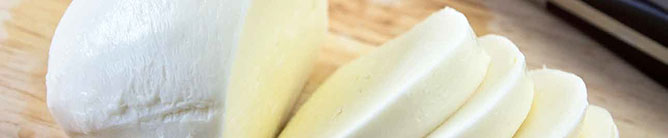
9. Knead the curds like bread dough and continue to do so until the cheese is smooth and shiny. Add salt near the end of the kneading process. Knead into a ball and cool. Enjoy!
A few tips to help you out:
- Any kind of milk can be used, but whole milk will provide the best result. Also make sure that your milk is not ultra-pasteurized.
- It’s important to thoroughly clean and sanitize your work area.
- If you are having problems with milk forming a curd during the first heating, the temperature may need to be increased to 95°F or even 100°F.
- When adding the rennet, stir in a top to bottom motion for no more than 30 seconds. Just enough to get the rennet evenly distributed.
- Salt used in cheese needs to be non-iodized. Sea salt works best.
- The leftover whey can be used in soups, bread, and even drinks.
Go Beyond the Activity
- Try using different milks to make the mozzarella and observe the differences between the milk fat content.
- Look up recipes for other cheese and see how they differ. Some other beginner level cheeses include ricotta, paneer, and cream cheese.
Download
Download the activity sheet for a formatted and ready-to-print version of this page.