
While all blood contains the same components and looks pretty similar to the naked eye, human blood contains microscopic markers called antigens. And if incompatible blood is mixed, it can mean the difference between life and death. In this issue, learn about different blood types, as well as their accompanying compatibilities and incompatibilities.
Watch our video to see blood testing in action!
| Featured Kit Blood Test Kit 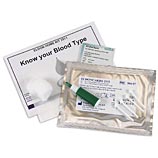 This single-use blood type test kit contains everything needed to perform a complete blood test at home for ABO and Rh factor. It’s a quick and reliable way to identify your blood type. With this test kit, you’ll get a blood test card, sterile lancet, dropper, alcohol prep pad, mixing sticks, and illustrated instructions. This single-use blood type test kit contains everything needed to perform a complete blood test at home for ABO and Rh factor. It’s a quick and reliable way to identify your blood type. With this test kit, you’ll get a blood test card, sterile lancet, dropper, alcohol prep pad, mixing sticks, and illustrated instructions. |
Human blood is made up of four main components: red blood cells, white blood cells, plasma, and platelets. Red blood cells, or erythrocytes, carry oxygen through the body and make up a little more than 44% of our blood content. White blood cells, or leukocytes, which are part of the immune system, fight disease by attacking and devouring harmful cells. Platelets, or thrombocytes, initiate blood clotting by pinching together damaged arteries. White blood cells and platelets together make up less than 1% of our blood. Liquid plasma, which makes up 55% of our blood, carries nutrients to the rest of the body.
Blood group types (A, B, AB, and O) were first discovered in 1900 by Austrian Karl Landsteiner, who was trying to understand why blood transfusion recipients often died. Blood typing is based on the way red blood cells clump together or agglutinate. Agglutination is caused by the presence of Anti-A and Anti-B antibodies reacting with the A and B antigens in the red blood cells. The red blood cells in Type A blood contain A antigens that clump in the presence of Anti-A antibodies but have no reaction in the presence of Anti-B antibodies. Alternatively, the red blood cells in Type B blood have B antigens that clump in the presence of Anti-B antibodies but do not react in the presence of Anti-A antibodies. Type AB blood contains both A and B antigens and will agglutinate with both Anti-A and Anti-B antibodies. Conversely, Type O blood contains neither A nor B antigens and will not react with either Anti-A or Anti-B antibodies. This is why people with type O blood are called universal donors, while people with blood type AB are universal recipients.
Blood Rh factor is another important blood grouping system that was discovered in the late 1930s. It gets its name because it was first found in the blood of rhesus monkeys. Blood can be either Rh negative or positive and simply indicates either the presence or absence of a specific antigen in the blood. Reaction with the Anti-D antibody shows a positive Rh factor. No reaction with the Anti-D antibody indicates a negative Rh factor.
If an expectant mother is Rh-negative and the father is Rh-positive, the unborn baby can inherit its father’s Rh factor. If the Rh-negative mother’s blood mixes with the Rh-positive baby’s, the mother’s body could develop antibodies against the baby’s blood. To protect the unborn baby, often the mother will receive an injection to prevent this. More than 85% of people are Rh-positive.</p><p>In summary, there are four main red blood cell types: A, B, AB, and O, and each of those can be positive or negative for the Rh factor. So in all, there are eight possible blood types: A+ or A-, B+ or B-, AB+ or AB-, and O+ or O-.
See our blood typing lab with 32 included blood tests and the Erycard Blood Type Test Kit.
Blood Compatibility Project*
Use this project to illustrate blood type compatibility. If the color of the “blood” changes, it is incompatible. If the color of the “blood” stays the same, it is compatible.
What You Need:
- 16 cups filled with water (four for each blood type)
- Red food coloring
- Blue food coloring
- Pen or pencil and paper to record data
What You Do:
1. Fill 16 cups with water.
2. Put red food coloring in four cups. They’ll represent Type A blood.
3. Put blue food coloring in four cups. These will represent Type B blood.
4. Put blue and red food coloring in four more cups to make a purplish color; this will represent Type AB blood.
5. Leave only water in the last four cups; this will represent blood Type O.
6. Pour one of the red “A” blood type cups into another one of the “A” blood type cups. Since the color did not change, blood Type A is compatible with blood transfusions with blood Type A. Once you’ve recorded that data, discard the cup.
7. Next, pour another red “A” into a blue type “B” cup. Since the color changed to purple, Type A blood and Type B blood are not compatible. Make a note of this as well.
8. Then pour a different “A” cup into the purple AB blood type.
9. Finally, red type A will pour the last cup into type O.
10. Repeat the steps with type B, AB, and O and record the results.
What Happened:
Blood Type A can only be given to Type A and AB patients. Blood Type B can only be delivered to Type B and AB patients. Blood Type AB individuals can receive blood from everyone, but can only donate to other AB blood type patients. Blood Type O individuals can only receive Type O blood, but they can donate blood to every other type.
*Project adapted from www.lessonplanspage.com