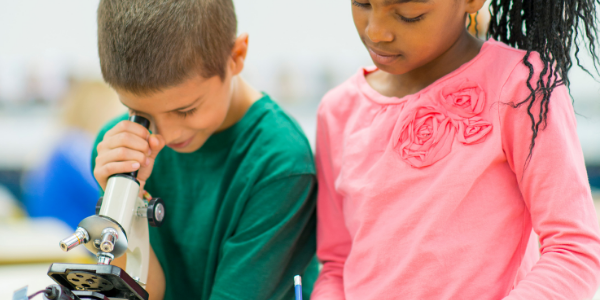
A homeschooling cooperative (often called a homeschool co-op) is a fantastic way to combine learning and opportunities for homeschoolers to socialize. Typically, families will meet once a week and students will learn together in a class setting. You may find that older students will meet more than once a week. The group usually follows the schedule for the entire school year.
Some topics lend themselves better to group learning, like the one offered in a co-op, and science tops the list. Here are just some of the benefits homeschool families can gain by learning science in a co-op setting.
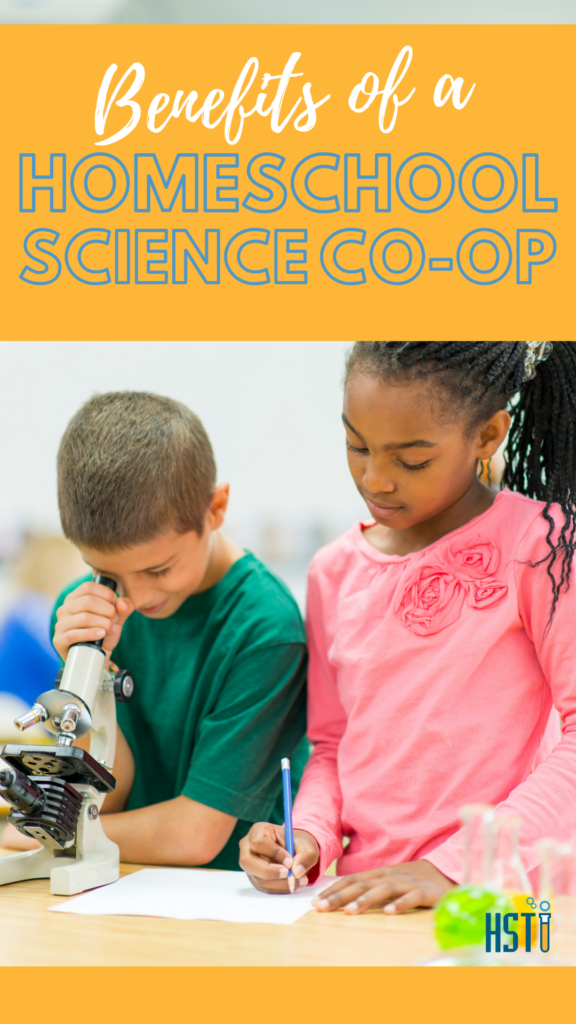
Benefits of a Homeschool Science Co-op Class
Accountability
Let’s be honest: Certain subjects are often put on the back burner. I love teaching science more than any other subject. But I confess to neglecting our science curriculum when all the “have-to-dos” vie for time in our schedule.
Meeting regularly for a co-op science class ensures that you complete science each week.
Outsourcing Your Homeschooling
We all have our gifts. Maybe you’re a natural at math or know how to speak a foreign language, but science (especially high school science) intimidates you.
If teaching science isn’t your forte, a co-op is a great way for your children to learn from someone who is passionate about it. Often, families can find a co-op with science classes taught by homeschool parents with science backgrounds. So, they can be sure that their children are getting not only a fun class but more importantly—quality instruction.
An added benefit is that students gain experience learning from a teacher other than mom or dad. This is an important real-life skill to master, especially if the student is college-bound.
Less Mess Means Less Stress
When asked what holds families back from doing more hands-on science experiments, the number one answer is usually the mess. The idea of doing chemistry experiments in the kitchen or dissecting a frog in the dining room isn’t always appealing. But when you’re part of a science co-op class, there is only one mess to clean. Students can pitch in to clean up, and since they’re having fun with friends, they won’t mind doing it. As the saying goes, many hands make light work!
Science is Better in a Group
Certain subjects are just more fun to learn as a group, and science is one of them. You can do many science activities in a group setting, such as playing games to review topics, giving group presentations, and conducting hands-on labs.
When learning about cells, students can create a cell model at home and present their model on co-op day. Alternatively, you can turn the classroom into a giant cell and the students can be chromosomes. Students can model the process of mitosis for a sure-fire way to bring the concept of cell division to life. In chemistry, students can play a game of Periodic Table Battleship or work in pairs to name ionic compounds. The entire class can play a game of Jeopardy to turn to review for a test into an enjoyable process. Experiments like dissections are also great in a co-op setting. I always pair a student who doesn’t mind dissecting with a student who would rather record data.
Additionally, a group setting with other homeschooling families may make keeping up with classwork more likely to happen. If each student knows that the teacher will collect homework at the beginning of class, they may be more likely to do the work–even when it’s challenging. Call it a healthy form of peer pressure.
Save Money on Science Supplies
Taking part in a homeschool science co-op is a great way to keep expenses down. Each family can pool their resources to buy consumable science supplies (vinegar, ammonia, and denatured alcohol for alcohol lamps) as well as scientific equipment. While it may not make sense for a single family to purchase the equipment necessary to do an acid/base titration, the investment is well worth it when split among the families participating in the class. The co-op can keep a science supply stash of dissection kits, pans, ring stands, hot plates, thermometers, and lab glassware for use year after year.
Things to Consider Before Joining a Science Co-op
While there are many benefits to learning science in a co-op setting, there are some things to consider before committing.
How Will Co-op Days Be Spent?
It’s important to have a clear goal for co-op meetings before you begin. How will you spend class time? Will the class teach new material, or will you use class time for hands-on labs and experiments, with students responsible for learning the course material at home? Alternatively, each session could be a mix of teaching and lab time. Either way, it is important to have a clear vision of how co-op sessions will be spent before you begin.
Where Will the Co-op Meet?
It’s important to find a suitable location for your co-op. If your group size is large, yo’ll want to find a location big enough to accommodate. Many churches offer the use of their classrooms for homeschool co-ops. If you are using a facility for your co-op, make sure you understand the requirements from the venue. The church or facility may provide a checklist of items your group needs to clean after each weekly meeting. Confirm that you are allowed to conduct science experiments in the space and ask for guidelines. For example, when doing messy experiments, you may need to cover the tables and/or floor to prevent damage or stains.
If your co-op is of a smaller size, you may find it easier to meet at someone’s home. My family spent many years as part of a small co-op composed of only four families, and we would alternate our meeting location among each of our houses. While one homeschool mom led a class in one room of the house, the other parents would spend time socializing in another room. Then, at the end of the day, everyone can clean up any messes made.
3 Homeschool Co-Op Class Ideas
- Health and anatomy. Study the human body. This curriculum from Apologia is a customer favorite.
- Robotics. What better way to teach STEM to all ages?
- Astronomy. Whether you’re teaching middle school or high school students, we offer a homeschool curriculum to make your astronomy class come to life.
Is a Science Co-op the Right Fit for Your Family?
For our family, participating in a co-op was a great way to make learning fun. The weekly classes held us accountable for staying on top of our school work, and the opportunity to get together with our friends, in addition to taking field trips, made our co-op something we looked forward to each week. Of all of the co-op classes my sons participated in, science was always one of their favorites. They were able to take part in hands-on labs and experiments that they likely wouldn’t have done if not for co-op and made great memories along the way.

Dr. Kristin Moon earned degrees in Microbiology and Molecular Genetics from the University of Florida. She left lab life behind to homeschool her two sons. After homeschooling her boys all the way through high school graduation, she spends her time providing lessons and resources to help other families provide a solid science education to their children from home. She is active on Facebook (Kristin Moon Science on Facebook) and she also provides family-friendly resources for learning about science on her blog: Science Simplified.